The Road to Publication

"Oh Well (2)" courtesy of Lydia Komatsu

“Oh Well (2)” courtesy of Lydia Komatsu

When I first started writing again, I’ll admit that I had a pretty narrow view of nonfiction. Just the facts, right? So when I enrolled in UAA’s MFA program, I thought I had everything figured out. It’s amazing what the addition of the word “creative” in front of “nonfiction” can do in terms of detonating paradigms. Within a few weeks, I was exposed to a world of possibility within the world of creative nonfiction. Not just essays either. Prose poems. Lyric essays. Open forms. I distinctly recall writing something for my online semester, then posting a silly comment about it being “flash nonfiction,” which I supposed was an imaginary genre. Our instructor, Sherry Simpson, let me down easy and recommended I check out Brevity. 

It turned out I hadn’t invented anything new. In fact, Brevity had been doing it for some time, publishing essays of 750 words or less. And boy, did those babies hum. Inspired, I had this foolish idea that someday, I could see some of my own work in Brevity. I even had something in mind – a short piece written from a class prompt that seemed to have promise, to hint at something more. 

There were a couple of breakthroughs – one when I decided to fragment the essay. Another big moment was when I embraced the attention to detail needed for such a short piece. I wrote the piece, and edited it about 30 times, which. Then I sent it off to about twenty journals and waited.

I wrote the piece after reading as many Brevity essays as possible, so to say that I wrote specifically for the journal is no exaggeration. Most places rejected it, but I did get one nice note from the editor of Grist, who said they liked it but it didn’t for thematically. Nice, but a rejection no less.

Brevity got in touch, but it wasn’t quite the home run I wanted. They wanted to see a minor rewrite – the conclusion, it was lacking. So I rewrote. Again. And waited some more.

When I received my acceptance email, I was ecstatic. After nearly six months of cutting and editing and agonizing over articles and nouns and format, there it was: Accepted.

At my second summer residency, Ron Carlson said something profound about writing. The reward, he said, was the same whether we get published or rejected; whether we win an award or fail to make the semi-finals. We get to keep writing. That stuck with me, and still does every time something good or not-so-good happens to me as a writer.

So, what’s next now that I’ve published something in an incredible journal?

I get to keep writing.

***

The piece, called “When We Played,” is available to read for free online here. I’d love to hear what you think about the essay in its comment section.

Book Review: “I’d Walk With My Friends If I Could Find Them” by Jesse Goolsby

Read This Book.

Read This Book.

Tom Ricks over at Foreign Policy was kind enough to publish my book review of USAFA graduate and all-around fantastic writer Jesse Goolsby’s debut novel. It’s a stunning, heartbreaking work that I can’t recommend enough. Especially if you want to read about war in a different way, one in which war recedes behind character-driven writing.

To read the full review, go here.

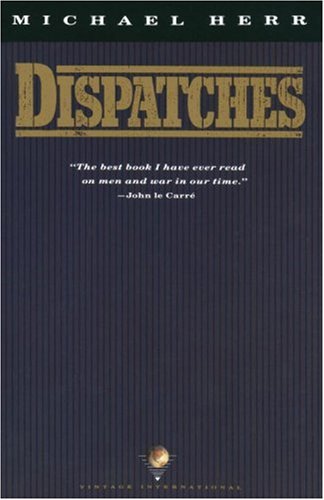
Reading War: Michael Herr’s Dispatches

41v0Ckz825LThe other day, I was talking to Brian Castner, author of The Long Walk, a brilliant memoir of the swath of time that surrounded his time as an Air Force EOD officer in Iraq. Like any discussion between writers, our talk made a left turn at “What are you reading these days?” I ran through two semesters of war memoir, but on the topic of Vietnam, he asked me what I thought about Dispatches. I, of course, bubbled like a fanboy; he on the other hand remarked that he liked it better as Full Metal Jacket, into which Herr folded Dispatches and co-wrote with Gustav Hasford for Stanley Kubrick. His point was that the structure of the memoir – fragmented and jumpy – seemed without a purpose besides self-indulgence.

He had a point – and it’s always tricky to understand the author’s intent from the narrator he creates on the page. Truth is certainly in the eye of the beholder in a case like this.

But I suppose my truth is different. The fragmentation of Dispatches to me was an attempt to get at the truth of not just war, but memory itself. Truth be told, what I call “straight ahead narratives,” or books structured chronologically, grate on me when it comes to memoir. It feels artificial to me, this tidy version of memory on the page. Give me the raw confusion of how the brain really works; jangled webs of brain cells all firing at once, sending our minds at one nanosecond to the third grade, and to our lost car keys the next. One moment the scent of lilac recalls an aunt’s perfume; the next, a vision of flowers that perhaps leads us to an altogether different memory until we find ourselves starting the car wearing one shoe, so distracted we have become.

This, to me, is the truth of memory and therefore, its documentation as memoir. It’s messy, confusing, difficult. A glorious mess. This isn’t to say that I can cruise through Ulysses over morning coffee. Or that I would want to. But I do love love the challenge of a fragmented memoir, which is why I loved both Herr’s and Castner’s. They both felt authentic. Dispatches jumps all over the the place, and his essayistic chapter “Illumination Rounds” is the strongest incarnation of this, literally a mosaic of memories conveyed with only two common threads: the narrator and the Vietnam War. It’s inspired at least two generations of like-minded war writers, and influenced at least two notable offerings: Brandon Lingle’s essay “I Thought You Were in Afghanistan” for Zone 3 and Donald Anderson’s memoir Gathering Noise from My Life. Fragmentation will always feel to me, closest to the experience itself.

Dispatches is not without its controversy — Herr has openly admitted to assembling the characters of Mayhew and Daytripper by stitching together notes taken from interactions with multiple real people — and stretching the limits of “creative” in “creative nonfiction.” Too, there is the matter of how he got there in the first pace; by talking Esquire into sending him to Vietnam simply to “write a story,” which evokes a kind of self-made man mystique that perhaps allows the author to craft a specific kind of narrator. But the controversies have not detracted from Dispatches‘ legacy as one of the key pieces of literature to emerge from Vietnam.

Dispatches is certainly on the must-read list of modern war memoir, but I also believe it has a lot to say to any author looking to cobble a story together from the disparate twines of memory. And about how to position your narrator to have deliver maximum impact. Oh, and just how creative you can get. And profane.

Oh, just read it already, and tell me what you think.