People of Influence

Tonight, as I stepped out into a damp, chilly SC night for my evening shake-out run, I somehow ended up thinking about my old coaches. I think maybe because I got home late from work, it’s dark out, and how as a young runner I was always putting off training runs until the last possible (and most inconvenient for everyone else) minute. I guess it got me thinking about external sources of motivation, which led me to the coaches I’ve run for over the years.

I remember Glen Gilderman, or “The Gilda” as we used to refer to him in high school. When I first showed up to my high school as a sophomore, my admissions person, an awesome lady by the name of Karen Snyder, recommended I go out for cross-country. I was hesitant, since I didn’t really run per se at the time, but she recommended it as a good way to meet people and make friends before the school year started in a few weeks. I showed up to my first practice, sans real running shoes, and had no idea what I was getting myself into, but I was hooked. I made friends that day who remain my friends today. Coach Gilderman was an inspired thinker, and aggressive to boot. I remember our first “mental training session,” which involved all of us lying on the ground as he talked us through a run visualization. I recall quite well that each session had to do with focus, and picking out first a tree, then a branch, then a leaf, and then most minute details of the leaf. Then, I’d usually fall asleep during the progressive muscle relaxation exercises, but it was great stuff. Coach Gilda had some legendary workouts, from hill continuations (thought you were done at the crest did you?) to twice-a-day tempo intervals during the pre-season team camp-out. He coached us to two appearances at State before leaving my high school to begin coaching in the newly-minted girls’ high school hockey teams, and he was sorely missed. He identified my weak mental game early on, and always encouraged me to believe in myself and my abilities. It was the first time a coach had ever talked to me about a mental approach to sport, and it left a lasting impression.

Then there was Lowell Harnell. Lowell was from Twig, MN, which he referred to (as I recall) as The Motherland. Garry Bjorklund is from Twig, and if you don’t know who that is, I can’t do nothin’ for ya. Anyway, Lowell spent time as Gilda’s assistant CC coach, and the middle distance coach for track, which is where I got to know him. He identified a good fit for me, very early on, in the form of the 800, which is a miserable distance if I have ever known one. Lowell was not long out of college, a founding member of GAT (Girls Are Trouble), and a perpetual source of dry humor. He lived just a few blocks away, so we’d occasionally run together in the summer break, and I often caught rides after practice with him. A few times, he tried to find some jobs for me helping out with his construction projects, but quickly realized I was worthless when it came to practical skills, and that was that. Lowell ran every workout with us, and demanded nothing less than our best every race. He had a glowering look about him that could cut right through your excuses and BS like a hot knife through butter. Then, after he called you out, he’d crack a joke and then it was back to business. Lowell broke his GAT pact not long after I graduated, got married, and I think both he and the Gilda are now coaching and teaching at the same school.

Mary Moline and Scott Johnson briefly cracked my code my senior track season, and coaxed me to a conference championship in the 800m, as well as a State qualification. They put me through the paces; in once early season dual, I found myself in the 800, the 1600, the 3200, the 4 x 400, and the shot put and discus. Most meets I tripled with at least an 800, the 300 hurdles, and anchor leg on the 4 x 400. But racing like that, as well as some pretty neat track sessions stolen right out from under UMD’s nose, got me where I needed to be. This summer, Scott happened to peruse the results of Grandma’s, saw my name and my time and immediately called to congratulate me. I owe him a mountain bike ride next time I’m back in town…

In college, it was Coach Mark Stanforth, “Coachese.” Coachese was a Trials qualifier and Chicago Marathon champ back in the day, and his approach to training was as legendary as his moustache. Coachese understood the unique demands placed on his athletes at the fine institution we competed for, and never tried to jam us into a training mold built off a normal school’s distance program. I don’t know what he saw in me, but for some reason he picked me up as a walk-on frosh, and he had my back until the day I graduated. I showed up with a PR of 4:40-something in the mile and 2:01 in the 800, which would barely have gotten me onto a DIII team, and my freshman year results were hardly spectacular. he placed me with The Scabs, as we came to refer to ourselves. We saw ourselves as the hangers-on, the back-of-the-packers, the lowiest of the low. Coachese saw something else in the group – athletes who maybe with a little bit of time, consistency, and a few pair of shoes, would turn into competitors. I don’t know how he managed it at our school, but he always managed to find creative ways to exceed his authorized roster, and I can honestly say I don’t know if would have made it through my higher learning experience if it wasn’t for track. The friends I made as a Scab are the guys who stood beside me in my wedding (performed the ceremony in one specific instance), and the guys whom I’ve stood by for the past eleven years. And occasionally, one of us Scabs would claw or way on to the varsity roster after enduring simply awful tempo runs on the Santa Fe Trail, or sweet Lord, thousands down at Monument.  In fact, my sophomore year, I dropped my mile PR from 4:40 to 4:19, and lettered my junior year. Coachese never did figur out how to get me to screw my head on straight, and I missed my senior season due to injury. But even then, he kept me on as a manager, even though all I did was occasionally help out by driving the van.

I’d be remiss if I didn’t mention Zane Castro, my long-suffering triathlon coach and now good friend and confidante. Zane bore my inability to remember  payment due dates with good humor, and my ignorance with patience. If I can credit anyone with finding ways to improve my mental game, it would be Zane C. Through hours upon hours of detailed delivery, Zane turned me into a believer and helped me develop realistically demanding mental approaches to sport. His techniques busted a decade of bad habits, and for the first time in a long while, I learned to enjoy competition and not fear it.

Each one of my coaches played a very important role in shaping who I am today, not just as a runner, but as a human being. I don’t think it’s any exaggeration to state that some of the things I’ve achieved as a person wouldn’t have been possible without some of the help these folks provided along the way. So, wherever all my old coaches are, I’d like to say that tonight as I rounded out a 16M day, I thought about you all and would simply like to say, “thank you” for the good influence you provided along the way.
7 for 7: Injury

I have no idea why I left injury for the conclusion to 7 for 7. Maybe it’s because I have such a sunny disposition. Who knows.

The list of injuries I’ve sustained while running range from the humorous to the frustrating. There was the time I ran into a hidden tree branch in downtown Denver and spent the evening in Denver General waiting for stitches. In retrospect, pretty funny. I’d give anything to have video of me as I ducked through what I thought were some leaves, but were actually camouflage for a ninja sawed-off tree limb. What aren’t typically very funny are your garden-variety “overuse injuries,” to use the catch-phrase bandied about by so many general practitioners whose last experience with athletics was that time they were picked last for kickball in 2nd grade. I love that phrase…”well, you overused it, so it’s hurt. Stop if you want it to not hurt.” Thanks a bunch, doc…

The injuries I battle most are plantar fasciitis and iliotibial (IT) band syndrome. The former is a painful swelling in the tissue on the bottom of your foot, usually concentrated around the heel; the latter is an inflammation of the iliotibial band, a long piece of connective tissue which runs pretty much from your ankle through your knee, and up to your hip. My plantar fasciitis is bad enough that it occasionally wakes me up in the middle of the night, but my IT band issues typically flare up and take off again if I spend some time on the foam roller.

I have no idea why I have these recurring issues. I have a feeling my IT bands are tired of being attached to my wickedly bowed legs, but the plantar fasciitis is beyond me. It showed up in 2005 for the first time in my life, and has been an uninvited guest ever since. I just sort of suck it up and do some painful golf ball massage when it gets really bad.

Running injuries in general can be incredibly frustrating for the reasons I allude to above – naturally we want to know the cause so we can fix things. But there is rarely an easy answer, except in the case of trauma. It could be just about anything, from physiological responses to life stress, to the complicated relationship of your core strength to your running stride. Thankfully, injuries that threaten to sideline you rarely show up overnight, which means an attentive mind can correct identify and correct issues early in the process.

 A powerful aid for this is your training log. As soon as something start feelings off, maybe a bit wrong. You need to write down as much info as possible and continue to document it throughout training. Nothing is worse than trying to figure out exactly when the pain started as you try to figure out possible causes. A good rule of thumb – if something painful develops and grows worse over about three days, you’re probably staring down the barrel of something bad and you need to intervene immediately. What that intervention looks like is completely individual. For some, it’s simply anti-inflammatory pain meds and pressing forward. For others, it’s aggressive deep tissue massage and plenty of ice…it all depends on the athlete and the injury.

Something else to remember about injury – it’s your body’s means of communicating with you. The message: “Dude, something is wrong and you need to fix it.” Overly conservative folks will immediately assume time off is the called-for panacea, but I tend to err on the aggressive side in that time off is usually the last thing on my mind. These days, I start with my core and my life. Is my core strong or have I neglected it for three months straight (the answer to that question is “yes,” which is why my lower back has been nagging me)? Am I recovering adequately between sessions with quality food and sleep or am I travelling tons, eating lousy airport meals and working 18 hour days? Find what is lacking, put it back in and see if it helps.

I’m not going to sugarcoat it: injuries suck. The disappointment associated with putting in the training, only to be derailed by a stupid injury should not be underestimated. However, I’ve never read a study that indicated self-pity was the Rx that cured the problem. It’s natural to be depressed and disappointed, but you have to turn that emotion into something positive…like ruthless determination to fix the problem and never have it again.

Injuries – they’re a big bummer but they hold important lessons for us if we have the foresight and wherewithal to make it happen.

I hope you enjoyed 7 for 7, because this iteration is officially over and out. Next time, I’ll try to deliver on the whole “7 days” aspect as opposed to 10…but I’m sure you didn’t mind a few days off J It’s been a good habit-builder to me as my day has started to feel incomplete if I don’t post at least a little something each day. I’m already dreaming up my next series, so keep alert for updates…

7 for 7: Racing

Where were we?

Oh, that’s right: Racing.

I’ve stolen a bit of my own thunder through the course of 7 for 7 and my weekend race report, so I’m going to quickly cover a few things about racing that are very important to me.

RESPECT

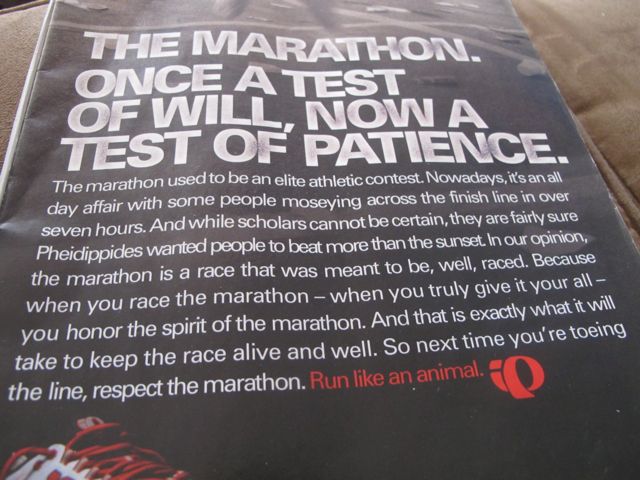
Sometimes advertisers don't lie...

It should come as no surprise that I love this ad, considering my elitist streak. Don’t get me wrong – some people train very hard, yet still run very slowly. “Can’t put in what God left out,” as Coach Stanforth used to say every season back on The Hill. I get that. What I don’t get are some of the people I saw at Chicago. I mean, really, lady? You’re walking on the course, talking on your cell in the middle of a race? How about you, dude? Is it necessary for you to update Facebook every mile? Seeing these people, knowing that my wife was out there having to maneuver her way around these clowns at the water stations…it really got under my skin.

Respect the friggin’ race, people (and I don’t think I’m talking to anyone who actually reads this blog). Whether it’s a 5k, a 5 mile, or a five day race, respect those of us who are out there to seek a better version of ourselves. If you don’t belong out there, then stay home. Make the sacrifice, and earn your spot on the starting line.

HEADPHONES

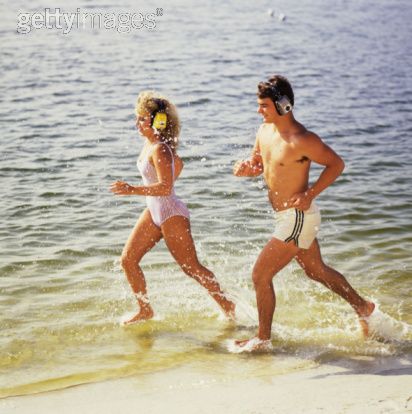
"What? I can't hear you over the sound of how awesome I am!"

Leave them at home. Racing is an experience that engages all five senses; how much do you miss out on when you eliminate 20% of everything you could possible take in? The simple, miraculous sounds of your own breathing; your name in exhortation; even the lousy music inevitably played at every race (Eye of the Tiger anyone?) – these are all a part of the experience, and things you miss out on when you tune out the world with your iPod/Nike+ Super Neato Keano Marathon Motivation Playlist. Want to use your little mental crutch in training? I won’t blame you…I run with mine all the time. But on race day, do yourself a favor and leave it home.

LEARN

Racing is battle, all else is prelude. As such, racing is our greatest opportunity to learn. It’s the battleground, whether your opponent is a real-life rival or simply your own weakness. You could learn that your local age-group rival is weak in the hills, or has a habit of starting way too fast. Maybe you find out that for all your physical training, your mind is not ready to attack the goal. Whatever the case may be – take the opportunity after a race to sit and think quietly for a few minutes about what just happened. If you really take the time to sit down and evaluate your performance, you’re going to recall some things that make you smile, as well as some that will make you wince. You need to pull it all together and not waste a great opportunity to learn.

Well, that’s all for today…I guess I should have called this series 7 for 11 instead of 7 for 7, huh? Oh well. Tomorrow, we end the series with an uplifting bit on…injury. Don’t worry – things are always better than you think they are.