Reading War: Michael Herr’s Dispatches

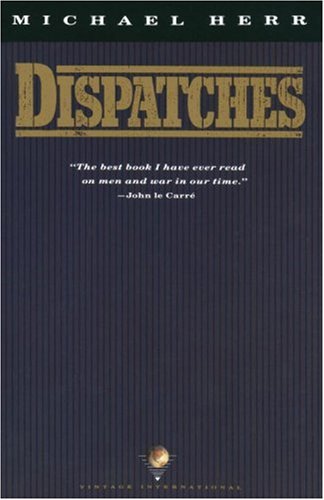
41v0Ckz825LThe other day, I was talking to Brian Castner, author of The Long Walk, a brilliant memoir of the swath of time that surrounded his time as an Air Force EOD officer in Iraq. Like any discussion between writers, our talk made a left turn at “What are you reading these days?” I ran through two semesters of war memoir, but on the topic of Vietnam, he asked me what I thought about Dispatches. I, of course, bubbled like a fanboy; he on the other hand remarked that he liked it better as Full Metal Jacket, into which Herr folded Dispatches and co-wrote with Gustav Hasford for Stanley Kubrick. His point was that the structure of the memoir – fragmented and jumpy – seemed without a purpose besides self-indulgence.

He had a point – and it’s always tricky to understand the author’s intent from the narrator he creates on the page. Truth is certainly in the eye of the beholder in a case like this.

But I suppose my truth is different. The fragmentation of Dispatches to me was an attempt to get at the truth of not just war, but memory itself. Truth be told, what I call “straight ahead narratives,” or books structured chronologically, grate on me when it comes to memoir. It feels artificial to me, this tidy version of memory on the page. Give me the raw confusion of how the brain really works; jangled webs of brain cells all firing at once, sending our minds at one nanosecond to the third grade, and to our lost car keys the next. One moment the scent of lilac recalls an aunt’s perfume; the next, a vision of flowers that perhaps leads us to an altogether different memory until we find ourselves starting the car wearing one shoe, so distracted we have become.

This, to me, is the truth of memory and therefore, its documentation as memoir. It’s messy, confusing, difficult. A glorious mess. This isn’t to say that I can cruise through Ulysses over morning coffee. Or that I would want to. But I do love love the challenge of a fragmented memoir, which is why I loved both Herr’s and Castner’s. They both felt authentic. Dispatches jumps all over the the place, and his essayistic chapter “Illumination Rounds” is the strongest incarnation of this, literally a mosaic of memories conveyed with only two common threads: the narrator and the Vietnam War. It’s inspired at least two generations of like-minded war writers, and influenced at least two notable offerings: Brandon Lingle’s essay “I Thought You Were in Afghanistan” for Zone 3 and Donald Anderson’s memoir Gathering Noise from My Life. Fragmentation will always feel to me, closest to the experience itself.

Dispatches is not without its controversy — Herr has openly admitted to assembling the characters of Mayhew and Daytripper by stitching together notes taken from interactions with multiple real people — and stretching the limits of “creative” in “creative nonfiction.” Too, there is the matter of how he got there in the first pace; by talking Esquire into sending him to Vietnam simply to “write a story,” which evokes a kind of self-made man mystique that perhaps allows the author to craft a specific kind of narrator. But the controversies have not detracted from Dispatches‘ legacy as one of the key pieces of literature to emerge from Vietnam.

Dispatches is certainly on the must-read list of modern war memoir, but I also believe it has a lot to say to any author looking to cobble a story together from the disparate twines of memory. And about how to position your narrator to have deliver maximum impact. Oh, and just how creative you can get. And profane.

Oh, just read it already, and tell me what you think.

The Loss of Pedro 66

“Soldier Antlers” by Lydia Komatsu

Last fall, I began drafting a new essay inspired by Dust to Dust, the Benjamin Busch memoir. There was this passage in which Busch recalled the moment of his mother’s death to cancer, only a year after his father Frederick Busch died. Reading that passage will always be for me the moment I knew I could go deeper with my writing. I won’t give anything away or quote the stunning prose – you need to read the entire work for yourself – but Busch does this magic trick in which he slows the moment of her passing. That, I thought, is how I would like to write.

Essay writing is a labor of love, as is any act of creativity. I’ve always taken this to mean “unrequited,” but lately learned it just means you must love what you are writing about. The situation must be near to you, precious enough to drive you to the page, tilting at the quixotic question: What does all this mean to me?

The essay began as a foray into the connection between my running and my wars, but ended up leading me down unexpected paths until when I finished and realized this is less about running than it is about loss and memory. Some of this was just evolution. Nonfiction to me was history books and journalism; but as I read and wrote through my first year of a Master’s Degree in Creative Nonfiction Writing, that word “creative” became more and more important.

In writing, we talk about what happened as “the situation.” It’s the who, what, where, when, why, and how of things. The “story” is how we choose to write about those things in order to bring forth what felt most true. When Pedro 66 went down five years ago on this date, the story was obscured to me for the longest time. I knew what happened to a certain extent, the situation that enveloped it. But I could not find the what it meant, and without that in hand, I couldn’t find a way to write about it beyond the chronology of events that exposed in me a raw grief.

Reading Dust to Dust taught me that the understanding the story isn’t about having the answers; rather, it’s about the pursuit. Seeking truth is the story in some cases, and to write in such a way as to illuminate it like Ben Busch did, well, I’d say that’s a good goal for an essay.  I don’t know why Mike Flores, Joel Gentz, and Ben White had to die on June 9th, 2010, but I do know that their deaths were meaningful to me. What went through their minds in their final moments can never be known, but that won’t stop me from trying to imagine it, even if it’s painful to do so. I will forever be in front of their caskets as long as I’m at the page.

Blue Skies, Brothers

Capt David Wisniewski, Pilot
1Lt Joel Gentz, CRO
TSgt Michael Flores, PJ
SSgt David Smith, FE
SrA Benjamin White, PJ

Reading War: Tim O’Brien’s If I Die In A Combat Zone

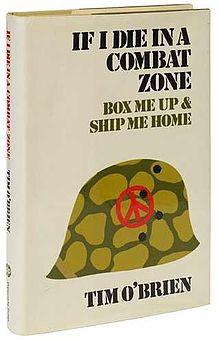
IfIDieInACombatZoneIn full disclosure, I’ve actually read (and own) every book Tim O’Brien has written. Which is not to say that I’m some kind of expert, just a big fan. His books got me back into the game of thinking about my wartime experiences as writing material.  If I Die is O’Brien’s war memoir, an account of his time with the ill-fated Americal Division in Vietnam shortly after My Lai occurred, and during the period of time the information went public.

I read all his fiction before I got to If I Die, so my expectations were fairly high. After all The Things They Carried and Going After Cacciato have emerged as some of the defining literature of Vietnam. After finishing If I Die, I recall disappointment. Not that it was a bad book, because it isn’t. O’Brien’s command of language and the written word is remarkable, but I simply expected more. Reading it again last year, the feeling was the same. Not bad, not great. And I might be in the minority opinion on the book, but here’s why…

There’s this idea in writing, that what finds its way to the page must be fully-formed by the author. And it’s this idea that is the achilles heel of the memoir. Produced hard (1973) on the heels of his deployment  from 1969-1970, I got the sense that the ideas put forth in the book were not fully grappled into submission. There’s this, which might be the most quoted line from the book: “Can the foot soldier teach anything important about war, merely for having been there? I think not. He can tell war stories.” Yet the book reaches far beyond merely telling war stories, and this creates a narrative conflict between reader and narrator because we’re asked to disbelieve that the narrator has anything important to say, even as he conveys things that are obviously important to him. Then there’s the fact that I completely disagree with the statement. You will too if you believe that any story is worth telling, and is important if only as a representation of the human struggle to understand our world.

O’Brien wrestles various topics into varying levels of submission within the memoir, but in the end, the book overall felt as much a stalemate as the war itself during that period of time. You might disagree with this adversarial take on memoir, but don’t confuse my take as a condemnation of ambiguity. In fact, ambiguity is an important issue for any memoirist and indeed the writing of memoir itself emerges from question: Does what I have to say matter? That being said, a reader must feel the importance of the narrator’s stance, regardless of whether he agrees with the stance itself. The reader should have an idea of the story means.

In the end, the memoir has a cast-off air to it, and I’m not sure O’Brien ever answers the other ambiguous question that must be answered in the writing: what’s this story about? Which leads me to wonder whether, if he’d have given himself more time to write the memoir, if it would have looked different.