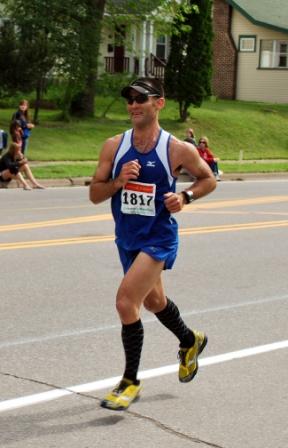
This dude looks like he needs a mindset boost

Something odd happens to me when I face a physically challenging task. If you know me well enough, you probably can believe it what I’m about to tell you.

Dude,  I start feeling sorry for myself, and when I say “sorry,” I mean sorry. Like take your sorry tail back home to mama kind of sorry.

This from a guy whose life literally revolves around physical challenges. I’ve labeled myself a lot of things in my adult life, and they usually “-er” attached to the end.  Runner. Biker. Climber. Kayaker. It’s never been a pastime either. I’m either going 100% or I’m out entirely. It frustrates Jen to no end (me too).

But before any hard workout, scary climb, or long ride I have always gone through an intense period of self-pity, thinking  “Oh man, I’ve got to do ____ and it’s going to suck.” Don’t get me wrong – I don’t back down. I get it done, and usually the monologue is entirely internal and goes away immediately upon assumption of the task. But underneath a calm exterior beforehand, is a maelstrom of lousiness.

I bring this up because as I talk about Mindset, it’s important to identify the mental pitfalls that will bring us down. Mindset is about really about one thing: tenacity. Call it “intestinal fortitude,” “warrior mentality”; call it what you want. What it boils down to is a mind that won’t accept excuses. So for those of us for whom mental domination doesn’t come naturally (which is just about everyone), it’s important to develop mental tactics which enable us to meet and exceed challenges.

Train like you race/race like you train. Racing is about 1% of what I do as I runner. 99% of running for me consists of training, of all things I do to get me to the start line. Training is what I have to to; racing is what I get to do after all that training. With that in mind, every run, every strength session becomes an opportunity to rehearse for race-day. In terms of mindset, it means not just going through the physical motions while ignoring the mental. One way I apply this in training is through the development of mental cues that will transfer seamlessly from training to racing. Mental cues are simple words, phrases, or memories I tuck away like little nuggets to pull out of my race-day toolbox. Some of the words I use: “Stop” with the visual of stop-sign if negativity starts to creep into my noggin; “Strong” with an image of myself as a runner built to be strong, capable of crushing hills and competitors with perfect form; and “Hammer” with the visual of putting sledgehammer through a brick wall. You might remember this phrase from my Grandma’s Race Report: “Fingertips-hips-lean,” which functions as a form check. Memories are a bit more difficult, but still a viable tool. As I train, I constantly look for experiences I can store away as reminders of what I am capable of doing. Before Grandma’s, I was on a 24 miler and hit a tough hill around 21 miles, which was right around where I knew I’d hit a tough hill on race day. So, with that in mind, I attacked the hill, hard. It hurt, but as I crested it, I told myself: “You remember this on race day. Remember how you dominated a hill at 21 miles on tired legs. Let it strengthen you.” And on the day, that’s exactly what I did. As I neared the hill, I recalled the memory and let it drive me past a handful of runners who were ahead of me.

It’s not about what you feel; it’s about what you do. This is something I didn’t really figure out until the past year. For the longest time, I always looked for that perfect feeling that meant I was ready to go. I would put off training runs by hours, simply hoping to feel better, somehow more ready. If I didn’t feel totally strong in a workout I viewed it as going poorly, making it that much harder on myself. Over the past year I’ve really had to come to grips with this issue and attack it at its root. Sometimes, no matter what you do (and you could be perfectly rested, trained, fed, etc), you will just inexplicably feel lousy. The ground truth is that you simply can not control how you feel. What you can control is what you do with this feeling. Two weeks ago, I had a tough workout scheduled: 6M at 6:00 pace or faster, 1M easy, then 3 x 1M at 5:45 with just 60s rest in between each mile repeat. To complicate things, the workout was scheduled for the day after flying, which always leaves my legs feeling pretty lousy. As I warmed up, I was not feeling good. I just knew it wasn’t going to be one of those effortless workouts. The first mile of the 6M segment proved me right – I struggled. I started down that old path of self-pity, then I remembered: It’s not about how you feel. I literally felt like a load was lifted from my mind. I no longer felt the pressure to not only perform, but to feel a certain way. Did it make the workout easier? Nope. It was still a tough one. But I hit my targets, and did it with a mind working for, as opposed to against, me.

Hope for the best, but have a plan for the worst. As a young runner, I depended on the idea that I would feel good in key races. When it didn’t happen, I fell apart and raced poorly. In military jargon, I lacked a “Go To Hell Plan,” which is to say I wasn’t ready for the variety of ways a race could unfold. So here’s the deal: if things go well and all the stars align and each step of your race is as blessed as the ones before, then bully on you. You’ll probably have to focus most on reigning yourself in as opposed to overcoming challenges. Understand, however, that those perfect days are rare. So best be prepared for the rest of the days. This translates to an application of what I’ve already talked about in terms of developing a sound approach and mental tools. As I approach races, I like to do run little mental checklists for what I’m going to do if things aren’t going as I hoped. For example, I imagine myself at a specific point in the race, and ask myself what I’m going to do if I feel like I’m working harder than I should. Maybe the response is that I dynamically re-frame my goals and fall back on a lower goal time. Maybe the response is that I need to work on gutting it out  so I tuck some mental cues away to get me through the bad times. You get the picture. Imagine what things are going to be like if things aren’t going as planned and have some plans in place so you aren’t taken down by a sneak attack.  

So, there you have it. Mindset by Matt. Sorry again for the late post -I’m literally finishing this standing up at a table in the Tampa airport. See you again tomorrow, and if I haven’t said it in a while, thanks again for stopping by.

7 for 7: Recovery

If you’ve been running for long enough, you know the type of person I’m talking about. He shows up to your running group, new guy with a lot of promise. He starts auspiciously – maybe a PR, maybe even a string of them. He nails every workout and MAN does he nail them! After a month or two, you’re wondering just how far this guy can progress. There just doesn’t seem to be any stopping this dynamo. But when you see him under the light of day, you notice the fatigue around the corners of his eyes, the dim look in his eyes. Your friends gossip about how so-and-so went on what was supposed to be an easy ten miler with Joe and ended up the victim of a death thrash that left him in the hurt locker for a week. Then, some minor hiccups. A pull here, a niggling ache there, all just minor complaints. He’s managing. Then, he goes strangely missing for like, a week. Where’s Joe, you and your running mates wonder. He shows back up, but just can’t seem to keep things together, never PRs again. He just sort of fades away into the cobwebs of memory, a cautionary tale that nobody can seem to remember.

Okay, maybe a little glammed up, a tad dramatic, but most of you know what I’m talking about here. Recovery, duh. Or rather, the lack of it, and how sustained lack of recovery will inevitably lead to breakdown.

First, you should know that my approach to recovery is not conservative in the least. When I was going through driver instructor training a few years back, I had a few instructors who thought I was behaving recklessly when I ended up off-track or plowing through some barriers. My response: “How am I supposed to know just where my limits are if I don’t go beyond them?” I apply the same mindset to running and recovery. I’ve pushed things way past what my body was capable of absorbing in a cumulative fashion. I’ve been injured multiple times, and played victim to more than one bug that took one look at my weak immune system and thought it would be a great place to camp out. Each time it’s happened I try to take away the important lessons – the early symptoms, the mindset that made me ignore them, and how to recognize and correct early next time.

Something else about recovery I alluded to yesterday – recovery is what happens when we’re not running. So while a “recovery run” sounds so nice and inviting, understand it for what it is – a means of stimulating recovery through a reduced level of intensity, but not something during which recovery on a cellular level actually occurs.

Lastly, since I’m starting to cut into my most important recovery aid (sleep), I will briefly cover perhaps the most esoteric aspect of recovery – how life affects it. for the longest time, I tended to approach running, and sport in general, as an isolated activity. A mathematical problem really: Add X, Multiply by Y, and you should arrive at Z. Over time, I’ve come to understand the necessity of accounting for just how much wear and tear our lives put on us. In fact, it would be very depressing to try to go through each and every stressor we face in our day-to-day lives. Unfortunately, you can not isolate an activity from the life to which it is connected. And if that life is full of stress it will inevitably have an impact on that activity.

As a result of this knowledge, I’ve had to become okay with dialing back training when things in the rest of my life aren’t going well, or stress is simply through the roof. I’ve also had to learn to accept that sometimes bad workouts happen after bad days.  At the risk of sounding psycho-babbly, I have to really force myself to accept these things, and it sure isn’t easy.

Wrapping things up: Recovery – it’s important. It’s what will keep you progressing, keep you uninjured and healthy. But don’t be afraid to test your mettle a bit when the timing is right. Just make sure you have an ice bath drawn and some compression sleeves ready to go…

Tomorrow, I promise to get the post up earlier. We’ll be talking Mindset. Should be cool.

7 for 7: Resources

One of the best things about running is just how little is required in order to do it. A pair of shoes (or not, if you’re hard), some clothes, and a patch of real estate are really all you need. Unlike some of my other pursuits, with about a hundred bucks or less you can participate. Of course, there’s always room for more gadgets, tools, specialized clothing, etc…but they’re all optional. You don’t need to drop a minimum of 750 to a grand on a lift ticket/board/bindings/boots/gear like snowboarding. The resources required to run are precious little.

For today’s post, I’m going to address the resources I employ in the pursuit of running, and I’ll go above and beyond the minimums addressed above. For simplicity’s sake, I’ll break them down into the following categories: Gear, Nutrition, and Recovery. Without any further delay…

GEAR

Say hello to my pretty ladies...

Shoes…if the picture above doesn’t say “fetish,” I don’t know what does.

There’s been a lot of talk over the past couple of years about minimalism. If you’re not aware, the shoe industry over the past 20 years has produced ever-increasingly over-engineered products. What began as a means of correcting biomechanical issues and offering more cushioning turned into production of $150 running shoes that looked more like NASA-produced moon boots than means of efficient movement. Recently, though, demand has turned away from these big clunky monsters, and more towards shoes that allow natural movement and muscle response i.e. “minimal” shoes. The evidence to support minimalism is still outstanding, Some say it’s better for you, while some say it’s dangerous. I‘m no scientist. I can tell you that personally, running in minimal shoes has always felt better for me, and my policy is that everyone should be running in as little shoe as possible.

Minimal shoes are characterized by varying lightness and degrees of heel-toe drop in the midsole. While non-minimal shoes run an excess of 10-12 oz a shoe, and 10-15mm of heel-toe drop (think of a down-sloping ramp due to there being more cushioning in the heel than in the forefoot), most minimal shoes start around 9 oz or less, and offer anywhere between 0-9mm of heel-toe drop. The heel-toe drop thing is important because the less gradient there is, the easier it is for you to foot strike in your stride midfoot/forefoot. Anyway, the shoes you see above run from less to more minimal from left to right. The Brooks Launch are the shoes I wear when I feel pretty beat up, sore calves, achilles, etc. The next two, The Mizuno Wave Musha 2, and the Saucony Kinvara are my workhorse shoes. I do most of my regular runs in them. The Saucony Grid A4 are next – those are my speed work/racing flats. Both the Kinvara and the A4 run a 4mm heel-toe drop, and are both very light. Last on the right are my Vibram Five Fingers, which are as close to barefoot as you can get. They’re basically slippers with articulated toes. I do all my strength work in them, and try to do a couple 3-5M runs a week wearing them.

Other gear: My favorite socks are Smartwool, and my favorite shorts are shorty shorts, preferably the ones with split legs. Yep, they may offend your sense of decency but on the back half of a hot track session that last thing I care about is your fashion sense. My favorite shirt the one I leave at home so I can run shirtless in hairy-chested manliness. My sense of minimalism clearly extends beyond my shoe selection, as you can see. The last piece of gear I will mention is my watch. I use the Garmin Forerunner 305, and that enormous hunk of wrist candy is an homage to my nerdy desire for accurate data. If I have a crutch, my 305 is it. I get all twitchy when I forget it, or the battery dies, or it’s acting up.

NUTRITION

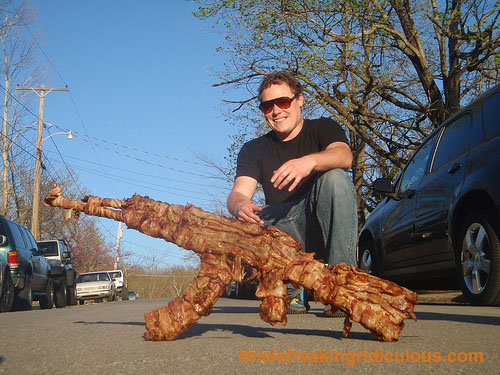
The latest in the fight against the Taliban...the BA-K-47. I would eat that weapon.

I think you might be surprised at how I eat. First, you should know that for years, I was a carb monster. Pasta, bread, taters, chips…my food pyramid looked more like…well, a block with some little ones on top of it. I scoffed at the idea that endurance athletes could subsist on anything but a carb-dominated diet. Then, two years ago, I noticed that despite the fact that I was running as much or more than I ever had, I couldn’t lose any weight. In college, I raced at around 160lbs; two years ago I couldn’t get under 190. Some of that was muscle, but some of it was definitely fat and the worst part was that where I used to be able to drop weight easily by simply running more, it wasn’t happening. Additionally, I was having increasing problems with fueling. I was running out of gas way early in training runs, and eating more wasn’t helping at all

So, I checked out this Zone Diet thing, which essentially re-apportions your food like this: 30% carbs/30% protein and fat/30% fiber. Additionally, it recommends cutting as much processed food and especially processed carbs out of your diet as possible. I ran with it, and so far the results have been good. I’m not fascist about it; I simply try to stick to the ratios. We also stick to organic and minimally-processed as much as possible. When I started, I was around 190 – since then I’ve dropped to 170-175 on average. My fueling issues are virtually non-existent. Where I used to have to take in a gel or some kind of caloric intake at least once or twice in a longer workout, I can now do 20-24M only taking on water and electrolytes. I probably go overboard on the protein and fat (1lb of bacon and a dozen eggs a week are nothing) and if I want to lose any more weight I’m going to shift to leaner meats and the “good” fats (nuts, olive oil, salmon, etc).

As far as running-specific nutrition, I use Endurance First Sports Ultragen mix as a recovery drink, and for gels I use Accelgels  since they have protein and the caffeinated Powergels for those late-race boosts. Propel is my drink mix of choice for both hydration during the day as well as during training.

RECOVERY

The one recovery aid we all need, but don’t get enough of, is sleep. Sleep is how your body repairs itself from the wear-and-tear of training, mostly through exponentially increased production rates of human growth hormone. Sleep is a big problem for me, since I like the night life…I like to boogie…8 hours is just about impossible, so I average between 6 and 7. However, most pro runners sleep 8-10 a night AND nap in the afternoons. I guess that’s my excuse for not being faster…

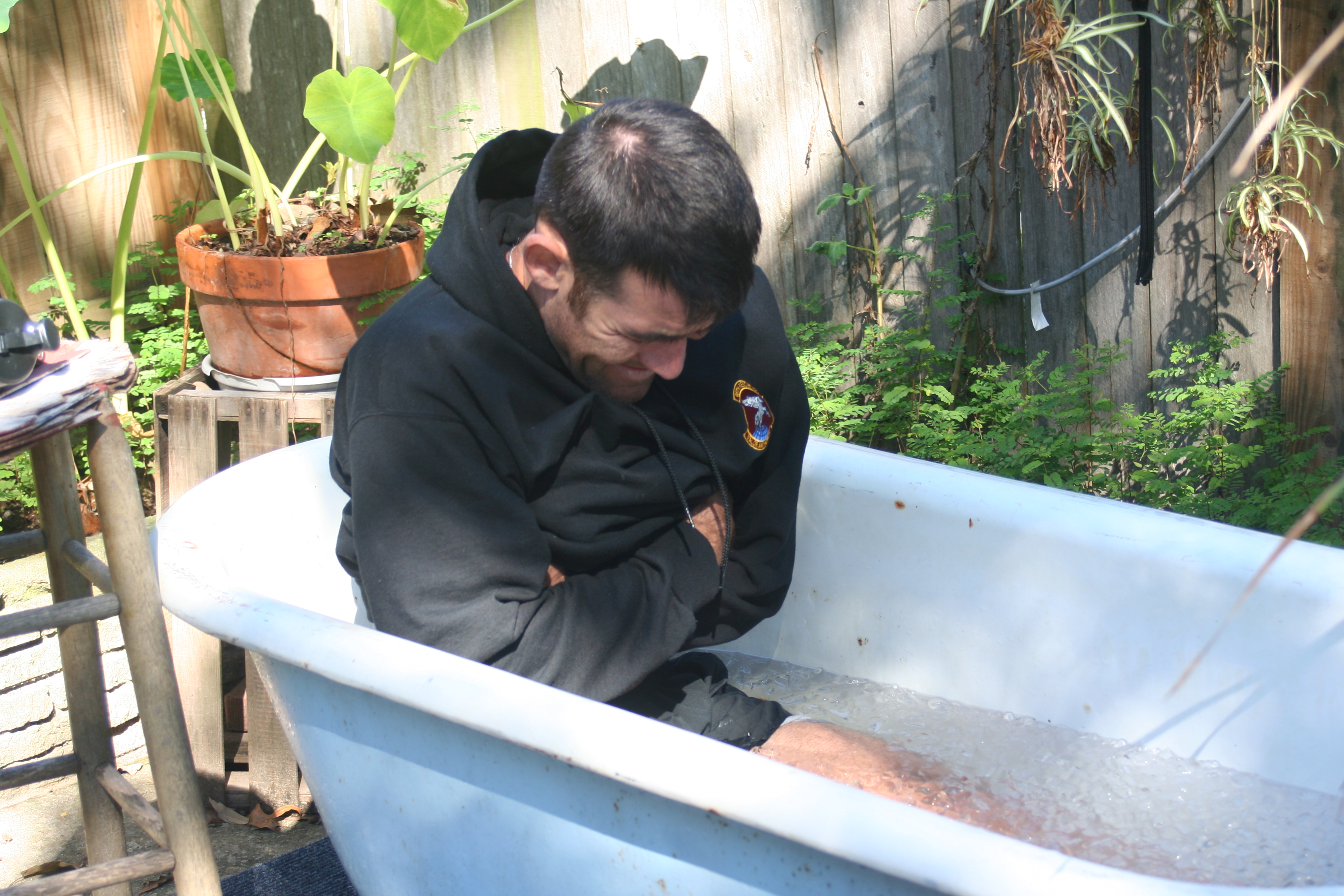
Another recovery resource I use is the time-honored ice bath. Cold, in general, is a very efficient means of both controlling the  inflammation associated with injury, as well as stimulating recovery through vasoconstriction (blood vessels contract, speed blood flow,

Who doesn't like a good kick in the junk?

 which helps move good stuff in and bad stuff out). In college, I took an ice bath every day, and when the runners showed up to the training room, the ball players and other athletes took off since they knew we were going to turn the cold bath Arctic by dumping a ton of ice in. These days, I have less of a tolerance for 37 degree baths, as evidenced by the photo on the right, but I’ve always heard the 50 degrees or so is about what you need to max out the effects. Just don’t try telling Whitis that…that’s his Dr Torquemada take on an ice bath I’m grimacing my way through in the picture.

The last recovery aids I will mention are compression socks/sleeves. Long in use by medical patients with lower leg circulation issues, they’ve come into vogue in the endurance scene in the past couple of years. The theory is that by constricting the blood vessels in the legs, they force more blood through and do the whole good stuff in/bad stuff out thing while you wear them. I use them after long runs or workouts, and now every time I fly to help minimize the amount of blood pooling in my legs during yet another cattle-car ride.

That’s about it for today…now you know I’m a hairy, bare-chested minimalist who sleeps too little, can’t handle ice baths, and wears funny calf sleeves. Check back tomorrow for my thoughts on the concept of recovery.