Approved.
I’ve been looking for a decent cold weather running jacket for several years. But, it just never made much sense to buy anything more robust than a light wind jacket when my coldest runs in SC and AZ might have approached a frigid 32F. Sure, the occasional winter excursions back to northern MN might mean some chilly jogs, but if I had 99 problems, a good running jacket wasn’t one.
Alaska, on the other hand, has been a much different story. Running in the winter up here is quite obviously legit. Last year, I made things work with my old wind jacket and a Patagonia jacket I got on sale at REI. Nothing was ideal, but it was better than nothing. Both jackets breathed very poorly, which led to a lot of frost buildup on the insides of the jacket, the fit for both is a bit wonky, but they worked so long as I layered appropriately. I made it through a winter of running, didn’t freeze off anything.
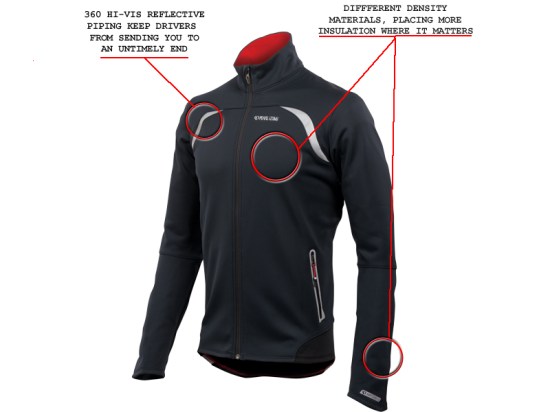
This winter, I was lucky enough to get my hands on the beauty you see above, in red. MSRP is $165 but sometimes you can find markdowns at the end of winter on Roadrunner or Runner’s Warehouse. Pearl Izumi is a company better-known for their cycling apparel, but they also have a line of running clothing. Their outwear is pretty much sport-independent; items like jackets are designed to apply to cycling, running, and pretty much any other cold weather athletic pursuit.
As I write more of these gear reviews, I’m realizing that in order to keep up with the other cool kids out there, I should start structuring these things more predictably. Someday I’ll get on top of that. Until then, you’re stuck with my scattershot approach. Oh well. There are plenty of reviewers that judge gear based on a single run, or a watch’s appearance for crying out loud; I can guarantee that what I tell you is backed up by my basic approach:
1) Nothing gets a review without roughly 100 miles worth of use. Shoes, jackets, shorts, whatever. When I say it’s been tested, it’s been tested.
2) I have no sponsors, unless you include your and my tax dollars. So, nothing I push or bash is based on a relationship with a corporate entity.
3) No nonsense, no bull. Take it or leave it.
So, here’s what I think about the jacket.
Bottom Line Up Front: Hands-down, best high-aerobic activity technical jacket I’ve ever worn, and it just so happens to be affordable.
1) The breathability of this jacket is simply outstanding. I simply have no tolerance for running jackets that don’t breathe, and you’d be surprised at the number of supposedly high-tech, expensive jackets that don’t breathe. The purpose of a running jacket is two fold – for one, it keeps the outside stuff out. Rain, snow, wind: a running jacket should keep all that nasty stuff off you. The other purpose is to move what’s inside, to the outside…namely, the perspiration your body creates. A running jacket that doesn’t do both doesn’t belong in your closet. I ran in everything from -20F to the high 20s, in hard winds, to driving snow. I am convinced that there isn’t a hardshell on the planet that can compete with a softshell when it comes to breathability, and this softshell in particular performed better than any other jacket I’ve tried. My breathability test is simple – run in the cold for a while, then stop. If I can see steam rising from the jacket, it’s doing what it’s supposed to do. Manufacturers want to throw numbers around, but they rarely mean squat outside the lab. This jacket steamed, and it steamed good.
I have another test for breathability: as soon as I finish a run, I strip off the jacket and look for signs of heavy condensation buildup. Are my forearms soaking? If it’s near zero, can I find large frost buildups inside the jacket? My experience is that most jackets struggle with the forearm sweat issue – the Fly solves this varying material density. The dense stuff is where you need it, the places most likely to be affected by cold wind. The chest, shoulders, and fronts of the arms are a nice, tightly-weaved windblocking material while the rest is more of a jersey-knit, allowing for greater breathability. Even so, I still found some condensation frost inside the jacket after a cold run. Just a touch in the forearms, and some in the lower back.
Now, I will say that in cold, wet regions, a hardshell would be more advantageous to keep heavy rain off you. I did not run in the rain in the Fly – but it’s billed as “water-resistant,” which means it probably won’t do much beyond a light drizzle.
2) Fit – A running jacket has to walk a fine line between too loose and too tight. Too loose, and excess material flaps around; more importantly, the jacket is too far away from the heat of your body to push your perspiration outside the jacket. Remember my basic maxim of cold-weather running: you are the heat source. Everything else serves to insulate and evaporate. Conversely, a jacket fit too tightly is constrictive, uncomfortable, and leaves your skin too close to the fabric blocking the wind, snow, etc.
That being said, the manufacturer describes the Fly as “semi form-fitting,” and I found that to be accurate. The drop-tail hem design, a nod to muddy/wet feet and rear bicycle tires, is appropriately loose, but the rest is *just* the right balance between tight and loose. I have large shoulders, and very un-runner-esque arms and chest for the time being, and I found the jacket to be perfectly comfy for running. Galen Rupp might have something else to say, but this stocky runner found that it fit as needed.
Other high points of the jacket include the hi-vis reflective piping, which got high nods from sleepy mates driving past me in the cold, dark AK mornings. Storm flaps on zippers and pit-zips are de-rigeur these days for any performance jacket, so nothing special there. If I had one complaint about the jacket, it was the internal fist mitts in the sleeves, which I found too short to be of any use to anyone without child-like appendages.
So, there you go. The jacket is priced competitively against other running softshells, but I’ve also noticed that when they go on sale, the discount is typically less steep that some of the other competitors. I’d recommend one, even at full price.


 Matthew Komatsu