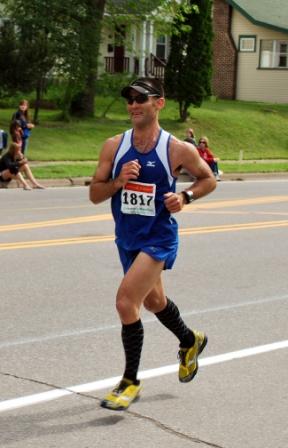
This dude looks like he needs a mindset boost
Something odd happens to me when I face a physically challenging task. If you know me well enough, you probably can believe it what I’m about to tell you.
Dude, I start feeling sorry for myself, and when I say “sorry,” I mean sorry. Like take your sorry tail back home to mama kind of sorry.
This from a guy whose life literally revolves around physical challenges. I’ve labeled myself a lot of things in my adult life, and they usually “-er” attached to the end. Runner. Biker. Climber. Kayaker. It’s never been a pastime either. I’m either going 100% or I’m out entirely. It frustrates Jen to no end (me too).
But before any hard workout, scary climb, or long ride I have always gone through an intense period of self-pity, thinking “Oh man, I’ve got to do ____ and it’s going to suck.” Don’t get me wrong – I don’t back down. I get it done, and usually the monologue is entirely internal and goes away immediately upon assumption of the task. But underneath a calm exterior beforehand, is a maelstrom of lousiness.
I bring this up because as I talk about Mindset, it’s important to identify the mental pitfalls that will bring us down. Mindset is about really about one thing: tenacity. Call it “intestinal fortitude,” “warrior mentality”; call it what you want. What it boils down to is a mind that won’t accept excuses. So for those of us for whom mental domination doesn’t come naturally (which is just about everyone), it’s important to develop mental tactics which enable us to meet and exceed challenges.
Train like you race/race like you train. Racing is about 1% of what I do as I runner. 99% of running for me consists of training, of all things I do to get me to the start line. Training is what I have to to; racing is what I get to do after all that training. With that in mind, every run, every strength session becomes an opportunity to rehearse for race-day. In terms of mindset, it means not just going through the physical motions while ignoring the mental. One way I apply this in training is through the development of mental cues that will transfer seamlessly from training to racing. Mental cues are simple words, phrases, or memories I tuck away like little nuggets to pull out of my race-day toolbox. Some of the words I use: “Stop” with the visual of stop-sign if negativity starts to creep into my noggin; “Strong” with an image of myself as a runner built to be strong, capable of crushing hills and competitors with perfect form; and “Hammer” with the visual of putting sledgehammer through a brick wall. You might remember this phrase from my Grandma’s Race Report: “Fingertips-hips-lean,” which functions as a form check. Memories are a bit more difficult, but still a viable tool. As I train, I constantly look for experiences I can store away as reminders of what I am capable of doing. Before Grandma’s, I was on a 24 miler and hit a tough hill around 21 miles, which was right around where I knew I’d hit a tough hill on race day. So, with that in mind, I attacked the hill, hard. It hurt, but as I crested it, I told myself: “You remember this on race day. Remember how you dominated a hill at 21 miles on tired legs. Let it strengthen you.” And on the day, that’s exactly what I did. As I neared the hill, I recalled the memory and let it drive me past a handful of runners who were ahead of me.
It’s not about what you feel; it’s about what you do. This is something I didn’t really figure out until the past year. For the longest time, I always looked for that perfect feeling that meant I was ready to go. I would put off training runs by hours, simply hoping to feel better, somehow more ready. If I didn’t feel totally strong in a workout I viewed it as going poorly, making it that much harder on myself. Over the past year I’ve really had to come to grips with this issue and attack it at its root. Sometimes, no matter what you do (and you could be perfectly rested, trained, fed, etc), you will just inexplicably feel lousy. The ground truth is that you simply can not control how you feel. What you can control is what you do with this feeling. Two weeks ago, I had a tough workout scheduled: 6M at 6:00 pace or faster, 1M easy, then 3 x 1M at 5:45 with just 60s rest in between each mile repeat. To complicate things, the workout was scheduled for the day after flying, which always leaves my legs feeling pretty lousy. As I warmed up, I was not feeling good. I just knew it wasn’t going to be one of those effortless workouts. The first mile of the 6M segment proved me right – I struggled. I started down that old path of self-pity, then I remembered: It’s not about how you feel. I literally felt like a load was lifted from my mind. I no longer felt the pressure to not only perform, but to feel a certain way. Did it make the workout easier? Nope. It was still a tough one. But I hit my targets, and did it with a mind working for, as opposed to against, me.
Hope for the best, but have a plan for the worst. As a young runner, I depended on the idea that I would feel good in key races. When it didn’t happen, I fell apart and raced poorly. In military jargon, I lacked a “Go To Hell Plan,” which is to say I wasn’t ready for the variety of ways a race could unfold. So here’s the deal: if things go well and all the stars align and each step of your race is as blessed as the ones before, then bully on you. You’ll probably have to focus most on reigning yourself in as opposed to overcoming challenges. Understand, however, that those perfect days are rare. So best be prepared for the rest of the days. This translates to an application of what I’ve already talked about in terms of developing a sound approach and mental tools. As I approach races, I like to do run little mental checklists for what I’m going to do if things aren’t going as I hoped. For example, I imagine myself at a specific point in the race, and ask myself what I’m going to do if I feel like I’m working harder than I should. Maybe the response is that I dynamically re-frame my goals and fall back on a lower goal time. Maybe the response is that I need to work on gutting it out so I tuck some mental cues away to get me through the bad times. You get the picture. Imagine what things are going to be like if things aren’t going as planned and have some plans in place so you aren’t taken down by a sneak attack.
So, there you have it. Mindset by Matt. Sorry again for the late post -I’m literally finishing this standing up at a table in the Tampa airport. See you again tomorrow, and if I haven’t said it in a while, thanks again for stopping by.
 Matthew Komatsu