The Loss of Pedro 66

“Soldier Antlers” by Lydia Komatsu

Last fall, I began drafting a new essay inspired by Dust to Dust, the Benjamin Busch memoir. There was this passage in which Busch recalled the moment of his mother’s death to cancer, only a year after his father Frederick Busch died. Reading that passage will always be for me the moment I knew I could go deeper with my writing. I won’t give anything away or quote the stunning prose – you need to read the entire work for yourself – but Busch does this magic trick in which he slows the moment of her passing. That, I thought, is how I would like to write.

Essay writing is a labor of love, as is any act of creativity. I’ve always taken this to mean “unrequited,” but lately learned it just means you must love what you are writing about. The situation must be near to you, precious enough to drive you to the page, tilting at the quixotic question: What does all this mean to me?

The essay began as a foray into the connection between my running and my wars, but ended up leading me down unexpected paths until when I finished and realized this is less about running than it is about loss and memory. Some of this was just evolution. Nonfiction to me was history books and journalism; but as I read and wrote through my first year of a Master’s Degree in Creative Nonfiction Writing, that word “creative” became more and more important.

In writing, we talk about what happened as “the situation.” It’s the who, what, where, when, why, and how of things. The “story” is how we choose to write about those things in order to bring forth what felt most true. When Pedro 66 went down five years ago on this date, the story was obscured to me for the longest time. I knew what happened to a certain extent, the situation that enveloped it. But I could not find the what it meant, and without that in hand, I couldn’t find a way to write about it beyond the chronology of events that exposed in me a raw grief.

Reading Dust to Dust taught me that the understanding the story isn’t about having the answers; rather, it’s about the pursuit. Seeking truth is the story in some cases, and to write in such a way as to illuminate it like Ben Busch did, well, I’d say that’s a good goal for an essay.  I don’t know why Mike Flores, Joel Gentz, and Ben White had to die on June 9th, 2010, but I do know that their deaths were meaningful to me. What went through their minds in their final moments can never be known, but that won’t stop me from trying to imagine it, even if it’s painful to do so. I will forever be in front of their caskets as long as I’m at the page.

Blue Skies, Brothers

Capt David Wisniewski, Pilot
1Lt Joel Gentz, CRO
TSgt Michael Flores, PJ
SSgt David Smith, FE
SrA Benjamin White, PJ
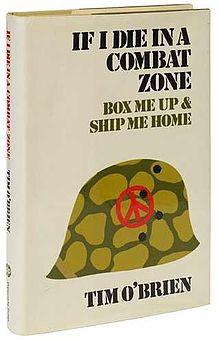
Reading War: Tim O’Brien’s If I Die In A Combat Zone

IfIDieInACombatZoneIn full disclosure, I’ve actually read (and own) every book Tim O’Brien has written. Which is not to say that I’m some kind of expert, just a big fan. His books got me back into the game of thinking about my wartime experiences as writing material.  If I Die is O’Brien’s war memoir, an account of his time with the ill-fated Americal Division in Vietnam shortly after My Lai occurred, and during the period of time the information went public.

I read all his fiction before I got to If I Die, so my expectations were fairly high. After all The Things They Carried and Going After Cacciato have emerged as some of the defining literature of Vietnam. After finishing If I Die, I recall disappointment. Not that it was a bad book, because it isn’t. O’Brien’s command of language and the written word is remarkable, but I simply expected more. Reading it again last year, the feeling was the same. Not bad, not great. And I might be in the minority opinion on the book, but here’s why…

There’s this idea in writing, that what finds its way to the page must be fully-formed by the author. And it’s this idea that is the achilles heel of the memoir. Produced hard (1973) on the heels of his deployment  from 1969-1970, I got the sense that the ideas put forth in the book were not fully grappled into submission. There’s this, which might be the most quoted line from the book: “Can the foot soldier teach anything important about war, merely for having been there? I think not. He can tell war stories.” Yet the book reaches far beyond merely telling war stories, and this creates a narrative conflict between reader and narrator because we’re asked to disbelieve that the narrator has anything important to say, even as he conveys things that are obviously important to him. Then there’s the fact that I completely disagree with the statement. You will too if you believe that any story is worth telling, and is important if only as a representation of the human struggle to understand our world.

O’Brien wrestles various topics into varying levels of submission within the memoir, but in the end, the book overall felt as much a stalemate as the war itself during that period of time. You might disagree with this adversarial take on memoir, but don’t confuse my take as a condemnation of ambiguity. In fact, ambiguity is an important issue for any memoirist and indeed the writing of memoir itself emerges from question: Does what I have to say matter? That being said, a reader must feel the importance of the narrator’s stance, regardless of whether he agrees with the stance itself. The reader should have an idea of the story means.

In the end, the memoir has a cast-off air to it, and I’m not sure O’Brien ever answers the other ambiguous question that must be answered in the writing: what’s this story about? Which leads me to wonder whether, if he’d have given himself more time to write the memoir, if it would have looked different.

Putting “We” In Memorial Day

“Soldier Antlers” by Lydia Komatsu

Memorial Day was always just another day off, a long weekend, an excuse to get my hopes up for what would be another

example of lousy Minnesota spring weather. I’m sure at some point, or at multiple points, adults explained to me the purpose of Memorial Day, but to a kid, I’m pretty sure that play time always trumps significance. He’ll understand some day, I’m sure they said as my black bowl of hair bounced away.

There’s this Bible verse, about being a child, doing childish things, then being a adult and acting like it. “Childish” always seemed pejorative but now I know that the nuance is innocence, and the things we do that are associated with the seasons and phases of our lives.

It actually took some time, to be honest. To realize that Veteran’s Day was actually my day now. It took two years of staring at a list of Americans still missing in Iraq to grasp the meaning of the POW/MIA flag. I had to lose friends in combat to understand the gravity of the word “Memorial.”

I used to get angry about people who wished me a “Happy Memorial Day,” or thanked me for my service on the last Monday in May. Wrong take, wrong day, I’d think. You don’t get it. But these days, that “you” has become increasingly problematic, the word a literal smoke screen from which to break contact and move to cover. “You” erects barriers, creates an “us,” and by extension, “them.” Veterans and Civilians, regarding each other from across a wide chasm.

I prefer “we.’

“We” acknowledges the ability to bridge any gap.

“We” recognizes and accepts difference.

“We” brings us together.

Which brings me back to Memorial Day, and seasons. I’m happy that for some, the day brings no sorrow because there has been no occasion to summon it. And I grieve for those for whom the day breaks darkly. But there is no singular truth to the meaning of the day beyond its stated origin, and if I have one wish about the day, it’s for connection. I hope civilians ask veterans if they’ve lost someone, and I hope veterans will respond and share their stories. In this way, Memorial Day will become another means of bridging the divide between us.