Reading War: Colby Buzzell’s MY WAR: KILLING TIME IN IRAQ

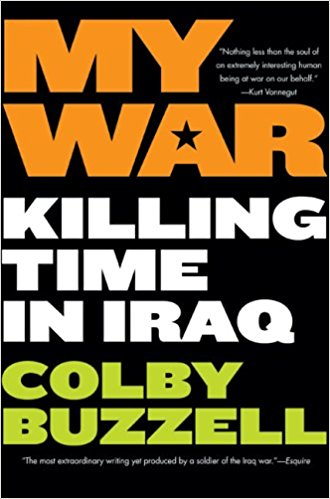
51WQ7SS1S9L._SX328_BO1,204,203,200_The other night, I had the chance to sit at a bar in Anchorage with Brian Castner and discuss a few things I’d mentioned in my blog post on All the Ways We Kill and Die. One of the things we talked about was the idea of the veteran writer who works both in journalism and the literary world; and how short the list really is. But one of the guys who we agreed could write great essays in addition to reportage was Colby Buzzell.

I’d have to check in with Pete Molin over at Time Now (he shared his far-more-intelligent-thoughts on My War here) but I believe that Buzzell’s My War: Killing Time in Iraq was one of the first, if not THE first, literary memoir to emerge from Iraq. First published in October of 2005, the flash-to-bang  on the memoir’s production was incredibly tight: Buzzell deployed to Iraq in 2003 with the Army, and came home in 2004. Which means what I’d estimate to have been less than a year to write and finish the book. Coincidentally, Buzzell deployed at roughly the same time as Brian Turner (My Life as a Foreign Country), who was also stationed at Ft Lewis, WA. Two remarkable writers in the same neighborhood: I have to wonder if their paths crossed at some point.

It’s hard to remember now, but blogging was kind of a new thing back then. Blogs were springing up all across the web, and being heralded as a kind of democratic approach to journalism. And those deployed to Iraq were taking advantage of the medium for a variety of purposes as well. I can recall coming across one while I was in Iraq, established by a guy I knew deployed at the same time as me, as a way of keeping his family updated. Colby Buzzell, on the other hand, was by all accounts looking for a way to pass the time. So he established an anonymous blog that ended up going viral. He’s still got the original blog posts up at Blogspot if you want to check them out.

I probably read the book within a year of its release and its raw prose blew me away. Unlike the repetitive autobiographies of trigger-pullers and generals, it was clear that Buzzell was grappling with the larger story of what it all meant. That last sentence is important to me in terms of taxonomy: for the most part, I don’t read non-literary war memoirs. If all you’ve got in your story is a bunch of things that happened to you, Godspeed. Those stories are important, and I’m glad they’re available. They are, or can be, art. A literary memoir, however, is at least trying to be Art, and does so by chasing the meaning of an experience.

That right there is the lesson of My War for war memoirists (and maybe even any author in general.) You need to be able to answer the question, “what’s this all about?” And my gut feeling is that answer can’t be, “it’s about me going to war,” unless you’ve got one hell of an exciting or unique perspective. There needs to be some kind of through-line. Slaughterhouse Five is certainly a war novel. But above that, it is about the moral complicity and guilt Vonnegut felt as a result of what he experienced during WWII.

My War answers the question adequately enough — and it didn’t hurt that Buzzell’s voice was fresh and unique. But most importantly, there’s enough connective tissue in there to take it beyond a disparate collection of things that happened and into literary territory.
Buy the book on Amazon.


Reading War: Anthony Swofford’s JARHEAD

Reading War: Anthony Swofford’s JARHEAD

The first time I spoke with an agent, he asked about my memoir manuscript.

“It’s a lot like Jarhead,” I said.

He shook his head. “Every one says that about their war memoir. Don’t say that.”

I don’t use the comparison much anymore, but it’s always on the back of my mind. Probably because Jarhead essentially broke the mold for literary war memoir. Others might be quick to raise their hand and point at Tim O’ Brien’s little-known Vietnam memoir, If I Die in a Combat Zoneas the genre-breaking prototype for contemporary war memoir. And I agree: it was the first to attempt essay collection as memoir. But it was still half-baked in my opinion. I don’t know enough, but my gut tells me it had something to do with not having any contemporaries from which to draw inspiration. It’s usually the first question I ask an author regarding their books: what were you reading when you wrote this book? In O’Brien’s day, creative nonfiction and its stepchild, literary memoir, was still busy being born. There were no Boys of My Youth (Jo Ann Beard) or even In Pharoah’s Army (Wolff, which pushes the form along) from which to draw inspiration. By way of example, consider contemporaries Phil Caputo’s A Rumor of War and Herr’s Dispatches: Caputo’s is very much a chronological story, while Herr’s is wild and all over the place. In the time in which O’Brien wrote his war memoir, writers are still stuck on the idea that memoir translates better as fiction (interesting note, Jo Ann Beard’s story “The Fourth State of Matter”, which gave birth to Boys of My Youth, originally ran in the The New Yorker  as short story – it was the only way they could fit that brilliant piece within their strictures of genre.) Point being: O’Brien’s series of linked, memoirist essays, still feels disjointed enough to feel like memoir, but not quite.

Twenty five-odd years later, enter Swofford. Creative nonfiction is booming, memoir is selling like hotcakes. There are plenty of examples to follow, as noted above. And what’s more, Swofford is studying at the most prestigious MFA program in the country, The Iowa Writer’s Workshop, where he’s surely being exposed to a litany of cutting-edge nonfiction.

Jarhead is Swofford’s account of his time as a Marine during Operation Desert Storm, but the book is much larger than that. Each chapter functions like a stand-alone essay, linked by experience, voice, and easy transition in order to allow the narrator to dwell on one particular aspect of that time of his life without regard for chronology or the expectation that one should begin at the beginning and end at the end.

It’s “THE war memoir,” according to the agent I spoke to that day: the one all other contemporary war memoirs are measured against. I’ve read a lot of them — nearly all of the literary ones — and the book deserves the honor it gets. It sold well, its release date concurrent with the onset of Operation Iraqi Freedom, and what’s more, it’s a remarkable telling of a screwed up human on the edge of the empire that teeters between raw emotion and gut-piercingly beautiful prose. The balance is remarkable, really. So good, some say, that Swofford will have a hard time surpassing it.

I try not to think of the comparisons too much, especially since I’m still working my way through the second draft of my own manuscript. But I’m always keen on drawing at least one lesson from each book I read. A lesson I can explicitly apply in my own work. And I’m not ashamed to say that Jarhead is my standard when it comes to translating war experience into an essay collection as memoir. It taught me a strong lesson in the idea that an essay can disguise itself as chapter, and that because a reader will recognize the comforting and familiar shape of such a thing, it offers a naturally occurring structure for the full exploration of an idea, thought, or theme.


Reading War: Matt Gallagher’s YOUNGBLOOD

Reading War: Matt Gallagher’s YOUNGBLOOD

Note: I reviewed Youngblood for Foreign Policy last year. If you’re interested in that take, which had to conform to Tom Ricks’ lethal editorial pen, you can view it here.

I had room to cram two books into the survival ruck I jumped onto the Polar Icecap last year. One of them was Matt Gallagher‘s debut novel Youngblood (I’ll get to that other one in another post.) I’d begun the book a few weeks earlier, so it was a bit of a risky move to bring a half-read book knowing I might be stuck on the Beaufort Sea for longer than expected. But I owed a review, and Gallagher is a damn fine writer, so it made sense on a lot of levels. The gamble paid off, big time.

In the space of one claustrophobic and very cold afternoon, I tore through the rest of the book. And cutting right to the chase: it was the Iraq novel I’d been waiting for.

Now, feel free to take all this with a grain of salt. I am, after all, a nonfiction writer, which means the lion’s share of my reading is nonfiction. But story is story. The Yellow Birds (Kevin Powers), Billy Lynn’s Long Halftime Walk (Ben Fountain)Redeployment (Phil Klay): they all filled a need. Namely, the desire to clear a guilty conscience. Respectively: the individual soldier’s, a nation’s, and the outsider’s. I take nothing away from each of those excellent books. They were necessary. The writing was outstanding. But they were also well, kind of depressing. 

Youngblood, by contrast, is best described as vibrant. It’s a technicolor story, complete with engrossing action and heartstopping literary value. Having met Gallagher now, and read just about everything he’s written, there’s a lot of the guy I had the pleasure of sharing a couple of drinks with in Youngblood. Which is not to say it isn’t a serious book — it is — but it’s also a hell of a lot of fun.

The basic premise is Iraq sometime during the Surge. Lt Jack Porter stumbles upon information about a troublesome NCO assigned to him, which leads Jack down an ill-advised investigative path that will twist and turn him on a plot line like something out of a hardboiled detective novel. Oh, and there’s that war-thing going on as well. And that’s about all I’m willing to share with you, because I want you to pick up a copy and read it for yourself.

I’d, of course read Kaboom, Gallagher’s memoir. So I was familiar with his wit, ability to turn a pretty phrase, and capacity for laugh-out-loud humor. But with Youngblood, you can sense Gallagher at a blank canvas, creating a world grounded by experience but broadened by creativity. What I took away from the book was a lesson in storytelling on the extended arc that a novel requires. Writing essays, longform, memoir, it took me a few years to come to grips with the idea that a writer must answer the pesky question, “what’s this about?”Not what happens — that much will be evident — but the thing that changes, the question that is answered, and so on. You must be able to answer the question as the author, or the reader will never have snowball’s chance in hell. That essay I’ve written about previous, “Calling Jody with the Ghost Brigade”: it wasn’t until I’d already begun submitting that I realized I’d written a lot of pretty sentences, compelling scene and assembled an interesting structure. But I couldn’t tell you what it was about. Once I decided that it was about the process of grief and memory, it made things a whole lot easier. I was able to dial things up here, eliminate dead weight there, so that once the reader hit the last sentence, they would be able to answer the question (I hope, anyway.)

One one hand, short stories and essays are disadvantaged by what must be an economical approach. A couple thousand words goes by pretty fast and you have to get to the point. Novels like Youngblood have the luxury of time and length to get the reader there. But the flip side of this is that length is no cure for inefficient and bloated writing. We’ve all been there, laboring through an extraneous chapter, wondering when we’re gonna get to the good stuff. But Youngblood had none of that. Gallagher keeps the story tight, clipping along, to the point that backstory feels less like a side-trip than it does a necessary pause.

So, there you go. Turns out novels can be good for your nonfiction. Especially if the novel you’re looking at for inspiration just so happens to be Youngblood.