Foundations: Strength for Endurance, Part 1

Sorry for how long it’s taken to put this out. When I first thought about writing on strength, I thought I’d share some general ideas and the like. However, I’ve ended up going down the rabbit hole a bit, reading the results of studies, and consulting some big brains for ideas. Anyway, I remembered I’m a Humanities major, not a Physiologist, and I’m supposed to write about stuff. So, let’s get it on…

What is “strength?” What does it mean to be “strong?”

If I have one frustration with the idea of strength as it relates to endurance, it’s how arbitrarily we bandy the term about. If someone “looks strong” in a race, we don’t generally say it unless that someone raced well. In all reality, the dude may be a 130lb weakling who couldn’t do a “girl” pushup with a gun up to his head, yet we have no problem calling him “strong.” What’s the deal with that? By the same token, I’ve had people look at me and based on my musculature, tell me I’m “strong as a G-D ox” and I have no need for further weight training. At the time, I was training to break 1:20 for the half-marathon, and I could barely run 7 miles without having to stop and stretch out my lower back due to core instability issues. I would posit that at that given point, I was “all show, no go,” as one of my former troops put it. It means I may have looked pretty, but it wasn’t doing much for me.

Are you starting to understand what I’m getting at here? The baseline, our approach and mindset on strength is all jacked up. It’s informed by a lifetime of crappy cultural inputs (movie stars with chiseled bods who can sprint for miles without breaking a sweat), cultish phenomenon (Crossfit as religion, anyone?),  and poor instruction. Finally, the truth is that there isn’t a big push within the sport to figure out the strength side. As I’ve done some research over the past couple of weeks, I’ve found out there is a reasonable amount of academic literature covering the effects of strength on endurance. But in twenty years of running and reading everything about running, I’ve never seen one of the studies I’ve been reading mentioned in an article, or even a book. What I find in all the training books are blips on “cross-training” that generally reflect strength training methods that went out of vogue sometime during the height of the Cold War.

So, it’s clear our old approaches to strength are generally broke. If strength is not a state of appearance or an indication of fitness, moving forward, here’s how we need to think of strength to effectively integrate it into endurance-related activities:

1) Strength is first and foremost a state of conditioning which enables endurance training to occur while minimizing, controlling, or eliminating injury. Look, the fact is that even 50 years ago, Americans were far less sedentary. People generally had far more active lifestyles and weren’t tied to cubicle and computer. They grew up chucking hay bales, working as mechanics, and *pushing* their lawnmowers (gasp!). They did things outside of running that kept them healthy as runners. These days, we’re what Mobility WOD refers to as “office athletes.” And of course, the sloppiness that goes along with hunching over a keyboard all day bleeds over into running. So, unless you’re reading this from somewhere in eastern Africa, chances are really good you should be doing strength to keep you running healthy.

2) Strength is the ability to generate force, enabled by mobility, over a period of time that matches your pursuit. Whether you run 5ks, ultras, surf epic sessions in Southern California for hours on end, or run big backcountry lines in Alaska; you need to be able to generate the force required to complete those activities successfully in the time allotted. It’s all about fueling your passion, to borrow some sorry corporate jingo. Strength is not the end, rather the means to the end. And it’s not about what someone else tells you should be able to do. If I have to hear one more Crossfitter talk trash about an elite marathoner’s alleged lack of overhead squat capability, I’m going to slap someone with their compression sleeves.

Subjective enough for you?

I hope so, because if it seems a bit vague, then you’re beginning to deconstruct a traditional mindset on strength and search for a new paradigm. Look: strength and endurance are incredibly complex issues, and we’re really just going to scratch the surface with this series. But I think in treating complexity, falling back on general principles gives us the ability to adapt as we learn more, and that is ideal in the face of uncertainty. Soooo, moving forward, here’s what you can expect. Over the next couple of posts, I’m going to cover methodologies, sport-specific approaches, and what I’ve been up to so you can learn from my mistakes and occasional success. Thanks to Kev, Eric, and Megs for leaving some comments requesting some topic coverage – guys, I hope I answer your questions. But feel free to call me out!
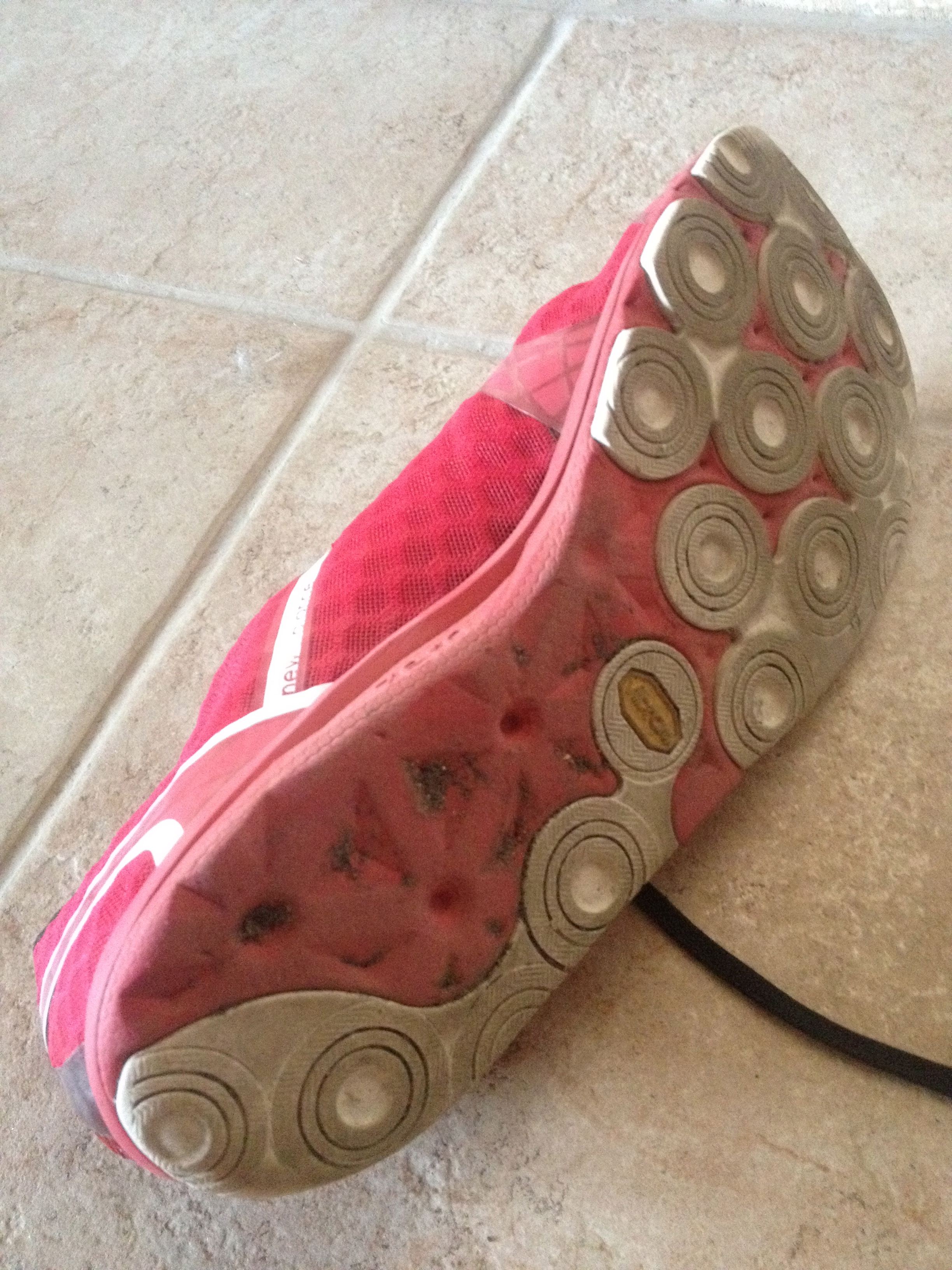
Low-Pro for Yo’ Go-Go: New Balance MR00

On my run home on Friday, I stopped by Skinny Raven , and picked up a pair of New Balance MR00. Running Times has a review here, but it’s pretty brief. I tried on the MR00 a couple weeks after they hit the market, around the same time I bought those slices of blue and black sponge cake masquerading as running shoes (Brooks Pure Flow). They fit my feet pretty well, despite having a bit of an elf-boot last. So far, I’ve only got about 10 miles on the shoes – I raced in them on Saturday (3.1), and ran home in them yesterday (7.5), so the jury is still out of course, but here are my initial impressions.

New Balance calls them “zero-drop” but Running Times says they have 1.6mm if drop; I couldn’t care less whether it’s 0 or one-point-whatever. The fact is that these shoes are very minimal when it comes to heel-toe drop, and I feel it when I run in them. In fact, yesterday, for the the first couple of miles, I felt some initial lower leg fatigue similar to what I recall from running barefoot or in my Vibram FiveFingers. I’ve been running in the MR10 for over a year now, and even the transition from the 10 to the 00 is quite noticeable.

The ride? Well, that’s interesting. I expected more of a race-flat feel, but what I’m getting is an ultralight trainer (6.4 oz) feel instead. Odd, right? While I raced in them on Sat, they just didn’t feel like racing flats, like my Asics Piranhas. They feel a little more stiff, and little more dense underfoot. I’m telling you – I need to do some more research on what New Balance is doing with their midsoles vs. everyone else…I’ve been terribly impressed with their ability to create minimal shoes that don’t ride all sloppy. For a guy my size (5’11”, 184lbs), a solid midsole is critical to achieve good proprioreception.

The outsole is done smartly. Vibram rubber only where you need it, and nowhere else. It’s a good idea, nothing new really, just running the midsole as an outsole in certain places, but it keeps it light. The sacrifice, and there’s always a sacrifice, could  be anticipated in shoe service life. I bet these bad boys don’t last me 300 miles.

Anyway, that’s it for now. Gotta run. I’ll let you know what I think as I put in some more mileage.

If I took dozens of artsy photos of my new kick reviews, but never actually ran in them…I’m sure this blog would be, like, super popular.
Check out the outsole Vibram pattern. Ideal for a mid-forefoot strike.

Race Report: Faster Than a Falcon 5k

Starting two Fridays ago, I was in Memphis for some awesome training with the boys. The days were long, hot, and muggy, which didn’t leave me with much gas at the end of the day. I did manage to squeeze in a couple of runs, but when you spend 12 hours a day on your feet, running around in full battle rattle, going for  a jog at the end of the day isn’t the first thing on your list. As if that wasn’t bad enough, I got about 5 hours of sleep a night, and usually knocked back a couple of beers around the table each night. Add some long travel days, and what arrived back in Anchorage Saturday night was a nicely de-tuned machine.

So this week was all about getting back into rhythm, but managing things so I didn’t end up overloading. An easy single on Monday, followed by a challenging double on Tuesday, to include AM strength work and afternoon with the Peak Performers again: 6 x 800m @ 2:36-41 with 2:00 rest. Wed was 6.5M in, and 10+ back out, Thu was an easy AM jog with Rider followed by 4 x 30s/45s/60s hard hills + strength; Friday was an EZ 6.5M home. By Fri, I accumulated 50M, two strength workouts, two Quality  (Tue/Thu) workouts, and eight separate runs. Not surprisingly, my legs weren’t exactly fresh when I woke up Saturday morning, but they weren’t supposed to be. I made the decision to “train through” the race, meaning I didn’t really take it easy during the week.

Jen, Rider and I loaded up and headed to Clark Middle School, in the Mountain View neighborhood of Anchorage. It’s an interesting place; low-income and a higher crime rate from what I hear. I guess a few years ago, some developers made a concerted effort to try and revitalize the neighborhood by putting in a lot of modern architecture structures and renovating homes here and there. The jury is still out on the long-term effects, but it was interesting to see some new homes with nice lines sandwiched in between pretty rough-looking joints. 100% of the race proceeds went to the Mt View Boys and Girls Club; last year they raised $7000.

Warmup finished, it’s time to get after it…

The course was pancake-flat, so as I warmed up I knew the terrain would be no excuse for the day. The weather was ideal – 40s and very little wind. If anything, knocking the rust off, and establishing a baseline for my current fitness were myobjectives. I harbored a faint hope that I might slip in under 17:00, but I knew it was a long shot. I shed my watch before I stepped to the line, which was something I haven’t done in a long while. I had no idea what kind of pace I might be able to run, and my intent was to simply run hard, with as little objective feedback as possible. Don’t get me wrong – having a GPS strapped to your wrist is an incredible tool in terms of data and instant feedback. But my mental game is terrible – there have been races completely wasted because I’m working hard, see a slower pace than I’d like, get negative, and tube the rest of the race.

When the starter released us, there were some kids who took off at a dead sprint, and I just let them go as I settled into a nice hard pace. By the time we made the first turn, about a half mile in, I was in the lead. I judged my pace to be around 5:15, but couldn’t be sure without my GPS. Somewhere before the first mile, I noticed there was someone was on my shoulder, breathing as hard as me. I thought about letting him pass with the idea I could catch a draft, but decided against it. As we approached 1M, he pulled even, and I was struck by how much he reminded me of my old friend and Academy running mate Patrick Shanahan. He surged just before the mile, and we both crossed in around 5:23-24 according to the person announcing splits. At this point a few things happened. I was a little disappointed I wasn’t moving more quickly based on my effort level, but tried to push it to the back of my mind. At this time, the kid was pulling away, and I lost mental contact until he had about 10 meters on me because I was too busy thinking about my split.

In retrospect, this was the critical point in the race. I should have covered his surge and hung on his shoulder. Instead, I just kind of minimalized him, thinking he might be a low-16s 5k runner, so I wouldn’t be able to stick regardless. But deep inside my little oxygen-hungry mind, a doubt registered: this guy is going to run high 16s, and if you don’t stick with him, you will not. I let him go.

Dry heave in action.

By Mile 2, he had a significant gap on me. I tried to keep up the positive self-talk. There were brief periods where I looked at the gap and felt like it was manageable to start closing it. I would take a couple of hard strides, but that was about it. Nobody announced the splits at Mile 2, so I had no idea how badly my pace was falling off. There are only two possibilities when you get passed: either you’re slowing down or whoever is passing you is speeding up. While I hoped it was the latter, I knew it was the former. Then I realized someone else was pulling even with me around 2.5M into the race. At this point, all I could think of was the finish, and there wasn’t a lot of positive rattling around in my brain. I matched his surge for a about 100m, then let him go. I was now in third.

That’s where I stayed through the finish, not even sprinting for the finish. I saw 17:32 as I crossed the line, and that was it.

I’ve processed the race over the past 48hrs, and there are both positives and negatives to take from it. On the positive side, 17:32 for my first race since Nov isn’t too bad. It’s only about 10-15s off my best mark from last year. It tells me what I did over the winter gave me a good cardiovascular base and capacity, and that my leg turnover didn’t suffer much. The speed is there. On the negative side, my lack of mental focus and tenacity yesterday was a little embarrassing. I should have hung with that guy until I was absolutely ad extremis and struggling. Instead, I took a mental break and lost contact with someone who could have helped drag me to a faster time. I’m not sure if I had a sub-17 in me yesterday, but I know 17:30 wasn’t the best I could have done.

Moving ahead, I have my work cut out for me if I want to break 17:00 by the end of July. But then again, putting in the work has never been an issue. Putting it all together on race day is the real challenge, and to get there my mental game is going to need some serious improvement.