Putting “We” In Memorial Day

“Soldier Antlers” by Lydia Komatsu

Memorial Day was always just another day off, a long weekend, an excuse to get my hopes up for what would be another

example of lousy Minnesota spring weather. I’m sure at some point, or at multiple points, adults explained to me the purpose of Memorial Day, but to a kid, I’m pretty sure that play time always trumps significance. He’ll understand some day, I’m sure they said as my black bowl of hair bounced away.

There’s this Bible verse, about being a child, doing childish things, then being a adult and acting like it. “Childish” always seemed pejorative but now I know that the nuance is innocence, and the things we do that are associated with the seasons and phases of our lives.

It actually took some time, to be honest. To realize that Veteran’s Day was actually my day now. It took two years of staring at a list of Americans still missing in Iraq to grasp the meaning of the POW/MIA flag. I had to lose friends in combat to understand the gravity of the word “Memorial.”

I used to get angry about people who wished me a “Happy Memorial Day,” or thanked me for my service on the last Monday in May. Wrong take, wrong day, I’d think. You don’t get it. But these days, that “you” has become increasingly problematic, the word a literal smoke screen from which to break contact and move to cover. “You” erects barriers, creates an “us,” and by extension, “them.” Veterans and Civilians, regarding each other from across a wide chasm.

I prefer “we.’

“We” acknowledges the ability to bridge any gap.

“We” recognizes and accepts difference.

“We” brings us together.

Which brings me back to Memorial Day, and seasons. I’m happy that for some, the day brings no sorrow because there has been no occasion to summon it. And I grieve for those for whom the day breaks darkly. But there is no singular truth to the meaning of the day beyond its stated origin, and if I have one wish about the day, it’s for connection. I hope civilians ask veterans if they’ve lost someone, and I hope veterans will respond and share their stories. In this way, Memorial Day will become another means of bridging the divide between us.
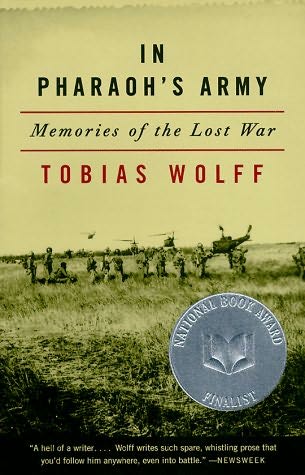
Reading War: Tobias Wolff’s IN PHAROAH’S ARMY

x8217You don’t have to get too far into In Pharoah’s Army to realize this isn’t your average Vietnam kill pulp. The memoir of Wolff’s time as an Army Special Forces officer in Vietnam explores all the nooks and crannies of the wartime experience that have nothing to do with combat, saving the kinetic stuff for a kind of sort brief, violent salve. It’s a remarkable book, the first war memoir I read before I knew “war memoir” was a thing.

Anyone who knows Wolff’s other work (say, The Barracks Thief or This Boy’s Life) can attest to his ability to use self-deprecation as a means of parsing the world. But what I found so entertaining about In Pharoah’s Army was the construction of a narrator who was lacking “the courage to admit [his] incompetence…was ready to be killed, even, perhaps, get others killed, to avoid that humiliation.” Wolff’s narrator takes us on a kind of hapless, malingering, and (of course) tragic journey through the Vietnam experience. He’s the antithesis of both the stereotype we apply to today’s Special Forces; he’s also the polar opposite of any kind of war lit hero archetype. It’s fascinating, because unlike Catch-22‘s Yossarian, whose nihilism isolates the character, Wolff’s narrator is quite accessible.

I suppose it might be a little disingenuous to some to compare fictional characters with nonfiction, but we all would do well to recall that any literary character found in either genre is at best, some kind of imagined thing. Any interesting character anyway…

I think it’s fair to call the memoir “essayistic,” with chapters that seem capable of standing as independent stories. The book itself is broken into three large sections that align with pre-, during-, and post-Tet Offensive. Of course, the prose is deft, the narration restrained, and the narrative arcs are controlled. It’s Wolff in the tradition of This Boy’s Life. But now the  boy has gone to war.

The last thing I want to mention in this short post is time. And not in terms of how long it took me to read the book, but how much time elapsed between Wolff’s deployment to Vietnam in 1968, and when he published in 1994. 26 years is a lot of time to sit on this kind of story. In the past decade, war writers of my generation are producing their war memoirs within five years of the experience. I don’t know if this is due to market forces, sharp agents, or editors with chops, but it’s worth noting. They’re putting out memoirs, and not just kill pulp, but real-deal-literature-that-kids-are-gonna-read-in-high-school: it’s coming hard on the heels of what are typically single deployments by non-career servicemen and women.

I don’t bring it up to say that we should be waiting 20+ years to tell our stories. I simply highlight it because it’s a perfect reminder that only the author can say when the story is ready for primetime. Some books probably needed to marinate a bit longer. Others, a bit less. And some, like this one, are just right after waiting a quarter-century’s worth of ripening.

Remember

Where I was 11 years ago is less important to me than the overwhelming sense of rage the day engendered. I recall I skipped my run that day in Richmond, VA. Just miles down the road from the Pentagon and all I could think was, “I should be there. I should be doing something.” Instead, I sat there, glued to the television like the rest of the world, watching those horrible images cascade across the screen until I was numb. When the cell networks finally became available, I called my family to let them knew I was alright – all they knew is that I was on a trip to Virginia.

One year later, I found myself marking the anniversary September 11th in Afghanistan, at Bagram Air Base. It was different time back then, a different war. Every American on base lined up in front of the CJTF-180 headquarters, known as “The Death Star” for its domed, pressurized structure. There were some media hanging around, and I recall it was a hot, dusty, busy day. This was long before counterinsurgency became the catch phrase of defense literati across the globe; before we paved roads, erected Pizza Huts, and sequestered ourselves inside impenetrable fortresses made of concertina wire and Hesco barriers. Before Iraq. Before we lost our way, and forgot lessons learned in the jungles of Southeast Asia.

Continue reading