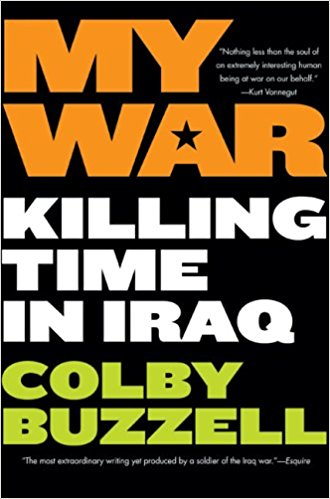
Reading War: Colby Buzzell’s MY WAR: KILLING TIME IN IRAQ

51WQ7SS1S9L._SX328_BO1,204,203,200_The other night, I had the chance to sit at a bar in Anchorage with Brian Castner and discuss a few things I’d mentioned in my blog post on All the Ways We Kill and Die. One of the things we talked about was the idea of the veteran writer who works both in journalism and the literary world; and how short the list really is. But one of the guys who we agreed could write great essays in addition to reportage was Colby Buzzell.

I’d have to check in with Pete Molin over at Time Now (he shared his far-more-intelligent-thoughts on My War here) but I believe that Buzzell’s My War: Killing Time in Iraq was one of the first, if not THE first, literary memoir to emerge from Iraq. First published in October of 2005, the flash-to-bang  on the memoir’s production was incredibly tight: Buzzell deployed to Iraq in 2003 with the Army, and came home in 2004. Which means what I’d estimate to have been less than a year to write and finish the book. Coincidentally, Buzzell deployed at roughly the same time as Brian Turner (My Life as a Foreign Country), who was also stationed at Ft Lewis, WA. Two remarkable writers in the same neighborhood: I have to wonder if their paths crossed at some point.

It’s hard to remember now, but blogging was kind of a new thing back then. Blogs were springing up all across the web, and being heralded as a kind of democratic approach to journalism. And those deployed to Iraq were taking advantage of the medium for a variety of purposes as well. I can recall coming across one while I was in Iraq, established by a guy I knew deployed at the same time as me, as a way of keeping his family updated. Colby Buzzell, on the other hand, was by all accounts looking for a way to pass the time. So he established an anonymous blog that ended up going viral. He’s still got the original blog posts up at Blogspot if you want to check them out.

I probably read the book within a year of its release and its raw prose blew me away. Unlike the repetitive autobiographies of trigger-pullers and generals, it was clear that Buzzell was grappling with the larger story of what it all meant. That last sentence is important to me in terms of taxonomy: for the most part, I don’t read non-literary war memoirs. If all you’ve got in your story is a bunch of things that happened to you, Godspeed. Those stories are important, and I’m glad they’re available. They are, or can be, art. A literary memoir, however, is at least trying to be Art, and does so by chasing the meaning of an experience.

That right there is the lesson of My War for war memoirists (and maybe even any author in general.) You need to be able to answer the question, “what’s this all about?” And my gut feeling is that answer can’t be, “it’s about me going to war,” unless you’ve got one hell of an exciting or unique perspective. There needs to be some kind of through-line. Slaughterhouse Five is certainly a war novel. But above that, it is about the moral complicity and guilt Vonnegut felt as a result of what he experienced during WWII.

My War answers the question adequately enough — and it didn’t hurt that Buzzell’s voice was fresh and unique. But most importantly, there’s enough connective tissue in there to take it beyond a disparate collection of things that happened and into literary territory.
Buy the book on Amazon.


Once A Runner

Once A Runner

It goes like this.

An inch of snow the consistency of a Slurpee. A 6.5 mile loop from the house. Two dogs. A running stroller loaded with thirty-three pounds of inquisitive man-cub. And the desperate need to run.

To say that I’ve logged the majority of my paltry mileage over the last few years while behind a stroller; it’s no exaggeration. Between developing chronic tendinosis in my Achilles, the pursuit of writing, and the endless flail that is trying to strike a balance between fatherhood/husband-ing/work, my fitness has fallen to the point of convenience. It shows around my middle, ten pounds tacked to my last marathon race weight. And in my temperament.

When I do get in a run, I feel an obligation to bring Finn with me for some fresh air and get the dogs exercise as well. An hour run turns into an hour and half, what with the prep of wrangling the dogs, getting Finn on the toilet, and wrestling him into clothes before restraining him in the stroller. And all this says nothing about the attempt to reach emotional buy-in from a toddler regarding his being strapped into a buggy for an hour or more.

Gone are the days of lacing up and strolling out the door maybe now, maybe later, maybe after I feel fully hydrated. Maybe when it’s warmer/colder/just right. Nope. The choice is now/never.

Huff huff.

Dada?”

Huff huff INHALE “Yes?” huff

“What’s that?”

Huff “What?” huff

“What’s that [insert unintelligible thing or whatever he sees but can’t describe]?”

Huff “Dada.” huff “can’t.” huff “talk.”

[pause for a few seconds]

“Dada, what’s that?”

huff huff huff

In the good old days, when he weighed seven or eight pounds, and was in perpetual oscillation between either sleeping a little or crying a lot, taking Finn for a run was a welcome reprieve for both Jen and I. Fitter then, pushing the light-as-air stroller we paid out the nose for, I could log ten, eleven miles. I’d come back crowing about how he slept the whole time I bounced along at a 7:30 pace. Jen got a break, I got a run. Win-win.

Now: see above for the work required. And that’s best-case, assuming no meltdowns, or as I discovered on a recent trip to tow him on a cross-country ski — I don’t do something boneheaded like somehow bring two left foot ski boots.

Taking Finn on a run or ski is like having the exercise partner who won’t stop talking. Except, the beauty of an adult running partner who talks for an hour straight is that they usually don’t expect a response. Finn is a toddling interrogator, and if he doesn’t get an answer, or understand it, well, he’ll just ask again. And again. And again. It would try the patience of a seasoned extrovert, let alone a self-absorbed narcissist who does best left alone (that’s me in case you’re wondering.)

I’ve been told that a big part of active parenting is lowering expectations, and in my experience, it couldn’t be more true. Maybe that six mile run needs to be just three. Maybe plan on stopping if the route passes a park. Maybe slow down so you have the breath to explain something. Maybe plan on skiing for fifteen minutes before heading inside for forty-five. Because — and here’s the kicker — if you make the kiddo hate the activity, that’s going to stick with them for the lifetime.

There is light at the end of the tunnel. Last summer, Finn asked to “run like Dada” every time we went out. I let him out near home, maybe a half mile to go, and was tickled when he managed to keep up a ten minute pace for several blocks. Of course, there were some really interesting leaves/rocks/branches/dirt/concrete/street signs/air/just about everything that simply had to be investigated at that very moment. But he was running. And this winter, I built a little snow hill off the backyard deck. Finn just learned to make it down the hill on skis without falling, and the smile on his face was worth all the hot chocolate bribery of last winter.

So, hang in there. What you once were, is still who you are. The cool part is letting that thing that made you who you were, evolve as you become who you are.

Reading War: Brian Castner’s ALL THE WAYS WE KILL AND DIE

Reading War: Brian Castner’s ALL THE WAYS WE KILL AND DIE

Note: I published a lengthy review of the book on The Millions, which you can find here.

Early on in the MFA program, I decided my goal was to write a war memoir. It was actually  was less evident to than you might guess — my original plan was an essay collection, but evidently those are difficult to get published as a first time author — but it also made a lot of sense. Technically, the very first thing I ever published was, after all, technically memoir. And by “memoir,” I mean it was an examination of something from my personal history.

The next logical step was to read as much war memoir as possible, which was how I became familiar with Brian Castner. An Air Force EOD veteran of Iraq, he wrote a memoir called The Long Walk (which has since been adapted as an opera) that stuck with me because of its fragmentary nature. It was willfully disorienting, the fragmentation a clear representation of a mind at search for a thread while weaving in and out of traumatic experiences. It reminded me, and quite a few others, of Michael Herr’s Dispatches.

Castner’s second book, All the Ways We Kill and Die: An Elegy for a Fallen Comrade and the Hunt for His Killer, is much different. Brian is also a freelance journalist with a fistful of longform/narrative nonfiction pieces, and the book is much more in the vein of reportage. By design, he’s told me, although I argued in my review that he as narrator is central enough to earn a “memoir” as a label as well.

In an MFA program like mine, you read a lot of nonfiction that weaves reportage and essay. Leslie Jameson, Eula Biss, John McPhee: these are just a tiny few who build narratives from both in-depth research and thoughtful reflection. In fact, modern creative nonfiction owes much to The New Journalism that erupted in the 60s from writers like Didion, Wolfe, and Gay. But once you narrow the lens to something like the idea of reading things written by veterans, well the list gets short. Really short. So while Castner’s second book was certainly beautifully written, it was also helpful and inspiring to see a fellow vet out there working the creative side and the journalism side.

Memoir, of course, requires a certain amount of research, even if it only consists of reaching into the depths of our memories to recall the who and where. But there’s something to the idea of dipping in and out, as the narrator in All the Ways does. One minute, we’re in his head, at his friend’s funeral. The next, we’re inside the head of a drone pilot. It taught me the value of the reporter’s skill of information gathering – of noticing in that particular habit of picking up stones to see what lies underneath. It’s a skill   foreign to me that, thankfully, Castner nails in the book.

Note: If you’re reading this in Anchorage or Juneau, you have the opportunity to interact with Brian Castner at one of several events next week. On Friday, 10 Mar at the Juneau Public Library, he will give a talk before leading a writing workshop the next day, again in Juneau. On Sunday, 12 Mar, I will moderate a discussion between Brian and and Alaska author Don Rearden at 49th State Brewery at 7pm. I hope to see you there.