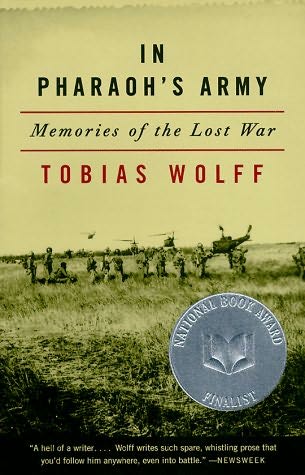
Reading War: Tobias Wolff’s IN PHAROAH’S ARMY

x8217You don’t have to get too far into In Pharoah’s Army to realize this isn’t your average Vietnam kill pulp. The memoir of Wolff’s time as an Army Special Forces officer in Vietnam explores all the nooks and crannies of the wartime experience that have nothing to do with combat, saving the kinetic stuff for a kind of sort brief, violent salve. It’s a remarkable book, the first war memoir I read before I knew “war memoir” was a thing.

Anyone who knows Wolff’s other work (say, The Barracks Thief or This Boy’s Life) can attest to his ability to use self-deprecation as a means of parsing the world. But what I found so entertaining about In Pharoah’s Army was the construction of a narrator who was lacking “the courage to admit [his] incompetence…was ready to be killed, even, perhaps, get others killed, to avoid that humiliation.” Wolff’s narrator takes us on a kind of hapless, malingering, and (of course) tragic journey through the Vietnam experience. He’s the antithesis of both the stereotype we apply to today’s Special Forces; he’s also the polar opposite of any kind of war lit hero archetype. It’s fascinating, because unlike Catch-22‘s Yossarian, whose nihilism isolates the character, Wolff’s narrator is quite accessible.

I suppose it might be a little disingenuous to some to compare fictional characters with nonfiction, but we all would do well to recall that any literary character found in either genre is at best, some kind of imagined thing. Any interesting character anyway…

I think it’s fair to call the memoir “essayistic,” with chapters that seem capable of standing as independent stories. The book itself is broken into three large sections that align with pre-, during-, and post-Tet Offensive. Of course, the prose is deft, the narration restrained, and the narrative arcs are controlled. It’s Wolff in the tradition of This Boy’s Life. But now the  boy has gone to war.

The last thing I want to mention in this short post is time. And not in terms of how long it took me to read the book, but how much time elapsed between Wolff’s deployment to Vietnam in 1968, and when he published in 1994. 26 years is a lot of time to sit on this kind of story. In the past decade, war writers of my generation are producing their war memoirs within five years of the experience. I don’t know if this is due to market forces, sharp agents, or editors with chops, but it’s worth noting. They’re putting out memoirs, and not just kill pulp, but real-deal-literature-that-kids-are-gonna-read-in-high-school: it’s coming hard on the heels of what are typically single deployments by non-career servicemen and women.

I don’t bring it up to say that we should be waiting 20+ years to tell our stories. I simply highlight it because it’s a perfect reminder that only the author can say when the story is ready for primetime. Some books probably needed to marinate a bit longer. Others, a bit less. And some, like this one, are just right after waiting a quarter-century’s worth of ripening.
Guest Post by Amalie Flynn: Excerpts and Thoughts from WIFE AND WAR

When I finally joined Twitter, I realized its potential for connection with other writers across the globe. I became familiar with Amalie Flynn, a poet and author of a memoir of war that represents the perspective of the spouse, and I’m a big fan. Womens’ voices in war lit are vastly under-represented, and a side of the story that deserves to be heard. I asked Amalie to share a bit of this, and I’m pleased she agreed. Enjoy!


"Bye and Stuff" by Lydia Komatsu

“Bye and Stuff” by Lydia Komatsu

Wife and War / Amalie Flynn

 He tells me how, he knew someone, over there, whose job it was to examine the dead bodies, look at photographs of suicide bombers, after they blew themselves up, study the scene, count the limbs, and chart the movement of bodies across highways.

How there was a meeting, in Kabul, about this, and the photographs of bodies were projected onto a screen, so he could see, a tongue coming out of a head, a head with no body, cut off right at the base of the neck, where the collarbone should start.

You don’t know what that is like, he tells me, turning away, a gas can in his hand, kneeling beside our lawn mower, looking, back, up at me.

And he is right.

I don’t know.

But I know about bodies. I know the bodies followed him home, disseminated, in pieces. I know he is still trying to put them back together. How Afghanistan is so broken by war and how he just wants to go back and try to put it together.

I know I am still here, holding this paper house together, four walls and a roof, holding our marriage in my hands, like a struggling bird.

(Wife and War, 2013)

 ***

My husband went to war in 2007. He deployed to Afghanistan for fifteen months. I can remember, now, the time he was gone, how the days stretched, like skin, into weeks, into months, and then into the body of a year. There was fear and dread and I thought about whether he would come home alive or if he would be killed. But my husband did come home. And, when he did, war followed him and created battlefields that I did not expect. I learned that every war has an aftermath, that going to war is hard, but coming home can be harder.

So much is said about the devastating effects of war in America, about soldiers who are killed-in-action, VBIEDs and lost limbs and TBI, PTSD, veteran suicide. My husband and I, we escaped this devastation. And, yet, when my husband came home, war crept into our daily lives, occupied our house, creating subtle battlefields, disconnecting us, shifting the landscape of our marriage, forming deep cracks. And we struggled, struggled to connect, again, and to move forward. In Wife and War: The Memoir I write about the quiet battles of war, the quiet of having a husband go to war and the quiet of having him come home.

 ***

There is quiet.

The quiet when he was gone, away in Afghanistan. Or this new quiet, here, in this house, now, now that he is home. The two of us, sitting across from one another at a dinner table, or lying next to each other, in bed, awake, eyes focused on separate walls, and not talking.

(Wife and War, 2013)

 ***

These quiet battles are an important reality of war. Because war leaves its mark. It leaves its mark, here, in America, on the soldiers who go to war and on their loves ones who wait. And it leaves its mark, there, abroad, in the countries where war is waged and where people wake up, every day, surrounded by violence and death.

 ***

The truth is that war and terror are this. An amputated leg, a dead body, a road littered with bombs, a lost country, with children, children like ours, living in war, and soldiers coming home, soldiers who have given so much, that they have nothing else to give.

(Wife and War, 2013)

 ***

War is not just my story. It is your story. War is not just the story of military families. War is our story, the story we all share. War covers our globe. Every day, there is more war, more conflict, more military action, more violence, and more death. But war is not abstract. Countries who wage war are not abstract. They are filled with people, with men and women and children, with lives and relationships and dreams just like ours. War crosses all boundaries. War crosses the boundary between one country and another, between what is foreign and what is intimate, until it covers us, all of us, with its deadly skin.


Amalie Flynn is an American writer and the author of two blogs: WIFE AND WAR and SEPTEMBER ELEVENTH. Flynn’s WIFE AND WAR poetry has appeared in THE NEW YORK TIMES AT WAR and in TIME’S BATTLELAND, has appeared in her blog for THE HUFFINGTON POST, and has received mention from THE NEW YORK TIMES MEDIA DECODER. Her SEPTEMBER ELEVENTH poetry has received mention from CNN. In addition, her WIFE AND WAR blog has a global readership, with readers from over 90 countries. WIFE AND WAR: THE MEMOIR is her first book.

Renovations Underway

"Oh Well (2)" courtesy of Lydia Komatsu

“Oh Well (2)” courtesy of Lydia Komatsu

Did you hear your radio crackle, just now? The static fuzz that tickled your tympanic membrane?

It was me. I’m back, and I’m dragging this blog into the future. Some things you’ll notice off the bat: name change, shiny new theme, and actual art as opposed to crummy stock images I culled from the inter webs. In fact, that last bit is the best news I’ve got: my sister is going to let me use some of her art, and promises to come up with some new work as well.

Continue reading