Thought some of you might get a kick out of this…note the serious competition on my left. Don’t get me started on having to run around folks who line up at the start where they don’t belong.
Whoever did this video did a pretty nice job, though…
Thought some of you might get a kick out of this…note the serious competition on my left. Don’t get me started on having to run around folks who line up at the start where they don’t belong.
Whoever did this video did a pretty nice job, though…
Ahhhh. The training. I love it, I hate it, I love it and hate it all at the same time. I love it for what it provides, but I hate it for the suffering it inflicts.
My take on training starts pretty simply: do it. Training is what gets us from here to there. It’s the one thing you can control in the process, really. You can’t control how you feel, your luck, or the genetic coding your parents passed along. Training is the one thing that not doing guarantees failure.
My second foundation for training is consistency. In his classic novel Once A Runner, John L. Parker Jr’s character Quenton Cassidy talks about a concept called “The Trial of Miles, Miles of Trials.” I think it accurately depicts the concept and importance of consistency. The miles required to achieve the goal, the sum itself is a challenge and opportunity for victory. In the same way, each one of those miles is its own little challenge and victory once completed. It’s a day in/day out commitment to put numbers in the mileage box of your training log, and watch as those numbers add up over weeks, months, even years depending on what you are trying to achieve.
Consistency is also perhaps the most difficult aspect of training to achieve, especially with life’s standard infringements. Work demands are my primary enemy when it comes to consistency. Having spent about six of the past twelve months on the road, I understand first hand the difficulty of staying on schedule.
My last, equally important approach to training is the importance of quality work. Quality work is what you might think of as “sprints,” but you might want to re-categorize as “anything harder than just going out for a jog/run.” This, combined with regular old running is what makes a program, and achieving goals requires both. Track intervals, fartleks, hill repeats, sustained moderate/hard runs…it’s all deadly.
Beyond the foundational tenets of doing the training, doing it consistently, and doing the quality work, there is the issue of methodology. I think of methodology as how you put it all together into a cohesive training program. There are many, many ways to train. From the ubiquitous cookie-cutter programs available on any online running website, to systems devised and led by individual coaches; there are simply a ton of options. I can find it a bit overwhelming, to tell you the truth.
I currently train predominantly off Coach Jack Daniels’ (I know, cool name, right?) methods. His book, Daniels Running Formula,
is starting to fall apart from me paging through it constantly. It’s in-depth as well as simple, and includes recommended training plans for runners of all abilities and distances. I also inject some of Michele’s workouts, which she took from Alan Storey. Unfortunately I don’t have any resources for him, which is unfortunate due to the fact that he’s got some killer hard workouts.

Chatting with Coach Jay at the 2010 Chicago Marathon Expo
He tells me that he’s working a research project on strength for endurance athletes, which I eagerly await. Additionally, Coach Jay Johnson, www.coachjayjohnson.com, has some wonderful stuff both on his website and in the podcast videos on www.runningtimes.com with regards to building a strong body capable of handling the toll running can take.
Here’s a depiction of the four weeks of training done prior to this week:
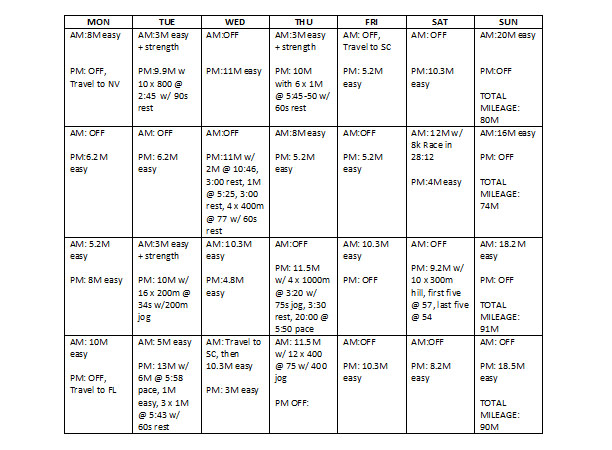
Training Snapshot for 1 Nov - 28 Nov
Alright, that’s it for today. Like I said, if I get going into the science stuff, you’ll be here (and bored) all day. Check out some of the links for more information if you’re interested. Hope you found all this informative…in the future I will probably post some of my own recommended training plans.
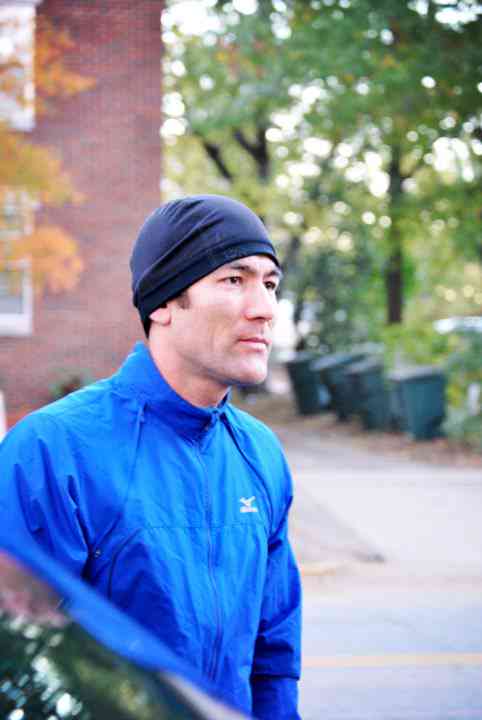
I must be very deep in thought at this moment.
Running philosophy. Man, is that a big topic to bite off, or what? It goes without saying (but I’m going to anyway) that there are plenty of philosophies on running out there. You have your “I just don’t get it” crowd, the bare-minimum amount of running fitness people, and the “can’t live without it/running is life” hardcores. There are even running philosophers: “Would you consider this workout an existential experience or more Socratic in method?”
My personal philosophy on running guides my approach to the sport, and it took me until this year to really put things together. I’m not going to tell you I came up with this totally on my own – Mark Twight’s articles on http://www.gymjones.com helped me pull together a decade worth of random thoughts. My running philosophy is based on a single premise: elitism. But it is not an “I’m better than you” brand of snooty country-club approach. My elitism looks like this: I’m better than me.
Confused?
Think about this…contrary to what we’re told from youth onward in order to build a healthy level of self-esteem, not everyone can be a winner. Sorry, but that’s just the way it is. There’s one first-place, and that’s where the elite finds himself if not often, then at least occasionally. To put myself under the microscope, I will never be an elite runner. You won’t see me winning Boston or chewing on a gold medal. Ever. I might climb the age-group rankings or someday the masters, but there will always be that caveat. Bummer. That’s just how it is, but this is the break point between mine and what I feel is the average attitude.
While actually being elite is beyond 99% of us, the elite mindset is something we can all share.
It is the endless pursuit of a better you, and a focused effort towards achieving that goal. Your non-elitist is the first to casually toss this out in conversation: “I could never (fill in the blank with and athletic feat).”
My response: “Really? How do you know? Have you tried? Have you failed? Have you picked yourself up and tried again?”
With great exception, the answer is no. It’s a cop-out, a lame excuse to get out of putting in any work in the first place. All I hear is laziness and/or fear. Psychologically, it’s a brilliant reinforcement for mediocrity. The response ought to be, “I don’t know if my full potential looks like that, but I’m pushing for whatever it is. I am not afraid to fail.”
The elite mind, then, is two things: 1) Willing to put in the work in order to realize potential and 2) Willing to overcome the fear of failure.
So, let’s bring this back to my philosophy on running and its foundation of elitism. As a runner, I am in pursuit of my full potential, and I orchestrate all efforts in support of that end goal. The ideal me is faster, stronger, and mentally unbreakable. The ideal me is the best runner possible at that particular place and time, and only I can judge whether or not I’ve achieved it. I work damn hard at achieving my goals, and despite having failed exponentially more times than I’ve succeeded, I continue to seek excellence. If it doesn’t mean I’m an elite, then I’m going to get as infinitely close as possible.
So, is this all well and good for me, but not really applicable to anyone else? Think you need to be “good” at something? Hardly. Elitism embodies the idea that the Journey could very well be the Destination. And (cue the chorus) it isn’t limited to running, or even athletic endeavors for that matter. But sticking to running, let me tell you how elitism fits for someone besides myself.
Most of you know my wife, Jen, ran the Chicago Marathon in October in 4:29. It’s not a particularly fast time, and she’ll tell you that herself. I firmly believe, however, that she embodied elitism in her undertaking. For example, did you know that this was her first race since high school? I also bet you don’t know that six months before Chicago, she could barely run three miles without feeling like death. With no background, no training, and nothing but faith, she set her goal of running a marathon, and doing so as fast as possible. Tell me she didn’t face a high risk of failure in this endeavor. And her work ethic? Committed, despite having do the hardest parts of her training in the middle of a South Carolina summer. Through the heat, the inglorious grind of accumulated training; even injury proved no match for her will. On race day, despite having missed several weeks of training, she put it all behind her. She went for it, and succeeded.
Inspired. It is the only word I can use to describe how I felt following her around the course on Oct 10th. While I am certainly emotionally biased (she’s my wife after all), I can honestly say that anyone who goes for it like that is an inspiration to me.
So, I guess that’s it on My Philosophy on Running, which I guess I could have titled “Elitism: Turns Out, It’s for Everybody.” I hope you found it thought-provoking, maybe even humorous. Feel free to take shots at me in the comments section…
Tomorrow, the next installment of 7 for 7: My love/hate relationship with all the crap you have to do before you actually get to the starting line.
 Matthew Komatsu