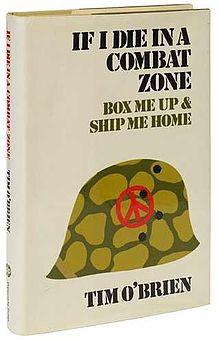
Reading War: Tim O’Brien’s If I Die In A Combat Zone

IfIDieInACombatZoneIn full disclosure, I’ve actually read (and own) every book Tim O’Brien has written. Which is not to say that I’m some kind of expert, just a big fan. His books got me back into the game of thinking about my wartime experiences as writing material.  If I Die is O’Brien’s war memoir, an account of his time with the ill-fated Americal Division in Vietnam shortly after My Lai occurred, and during the period of time the information went public.

I read all his fiction before I got to If I Die, so my expectations were fairly high. After all The Things They Carried and Going After Cacciato have emerged as some of the defining literature of Vietnam. After finishing If I Die, I recall disappointment. Not that it was a bad book, because it isn’t. O’Brien’s command of language and the written word is remarkable, but I simply expected more. Reading it again last year, the feeling was the same. Not bad, not great. And I might be in the minority opinion on the book, but here’s why…

There’s this idea in writing, that what finds its way to the page must be fully-formed by the author. And it’s this idea that is the achilles heel of the memoir. Produced hard (1973) on the heels of his deployment  from 1969-1970, I got the sense that the ideas put forth in the book were not fully grappled into submission. There’s this, which might be the most quoted line from the book: “Can the foot soldier teach anything important about war, merely for having been there? I think not. He can tell war stories.” Yet the book reaches far beyond merely telling war stories, and this creates a narrative conflict between reader and narrator because we’re asked to disbelieve that the narrator has anything important to say, even as he conveys things that are obviously important to him. Then there’s the fact that I completely disagree with the statement. You will too if you believe that any story is worth telling, and is important if only as a representation of the human struggle to understand our world.

O’Brien wrestles various topics into varying levels of submission within the memoir, but in the end, the book overall felt as much a stalemate as the war itself during that period of time. You might disagree with this adversarial take on memoir, but don’t confuse my take as a condemnation of ambiguity. In fact, ambiguity is an important issue for any memoirist and indeed the writing of memoir itself emerges from question: Does what I have to say matter? That being said, a reader must feel the importance of the narrator’s stance, regardless of whether he agrees with the stance itself. The reader should have an idea of the story means.

In the end, the memoir has a cast-off air to it, and I’m not sure O’Brien ever answers the other ambiguous question that must be answered in the writing: what’s this story about? Which leads me to wonder whether, if he’d have given himself more time to write the memoir, if it would have looked different.

Go, Tell the Tsunami

"Cloud and City" by Lydia Komatsu

“Cloud and City” by Lydia Komatsu

Longtime readers of this blog know that I wrote a series of posts about my time in Japan following the 11 March 2011 earthquake and tsunami. What you might not know is that I repurposed those posts into a seven minute oral essay on my experiences for the “Arctic Entries” storytelling event here in Anchorage. If you’re not familiar with Arctic Entries, it’s similar to NYC’s “Moth” as means of continuing the oral storytelling tradition. Seven storytellers get seven minutes (max) to tell one story a piece, on stage at Anchorage’s Performing Arts Center, in front of a couple hundred friends.

A friend recommended me for the December 2014 event, themed “Thicker Than Water,” and once accepted, I got to work writing a draft. I had this idea that I could somehow take twenty pages of material drafted for a new, unfinished, essay and turn it into this brilliant seven minute, fragmented story that would bounce around between various memories and wow the audience. After seven minutes of pugilistic story telling, I’d drop the mic and walk away to thunderous applause.

Drafting proved problematic. First, the draft was ten pages. Way too long. Then, I realized I had no idea how to tell a story with little regard for chronology without running the risk of completely losing the audience. I quickly abandoned the latter tack. But I still had the problem of length. On average, it takes about a minute to read (aloud) a page of double-spaced, 12-pitch font. At my first rehearsal, my story ran seventeen minute. That’s 7 + 10 if you’re a Humanities major like me. Not good.

Thematic control is so important to any short piece, and I had a hard time deciding what the story was about. Was it about being half-Japanese? Was it about losing my grandmother in the tsunami? Or was it about what I did or did not do as a part of the relief effort?

By my second rehearsal, the story was shaping, but still three minutes too long. So I flogged that pony some more, telling it over and over again, while Jen timed me and gave me feedback. The night before the event, I stood in the living room and told it once last time for the night: eight minutes. At least I was getting closer. At one point in the night, I ranted to my wife about the difficulty of condensing all this material down inside such a short timeline. The intro was taking far too long, and I felt like I was getting bogged down in the details. Frustrated, I gestured and whisper-shouted to avoid waking our son, when Jen stopped me.

“Wait, what did you just say?”

I paused, then tried to say it again, something about walking into my office, looking up at a tv, and watching Japan die.

“That’s it,” she smiled, “that’s your opening. One sentence that puts the audience exactly where you want them.”

The next day, I kept at it until about an hour before the show to ensure my timing was good, that I had a good handle on the story’s roadmap. You’re not allowed notes or props while telling your story, and I didn’t want to end up lost on stage, gaping through the silence into the dark. My last time telling it to Jen, I got it done in a shade under seven minutes, and I’m happy to report  that on stage, I made the time limit. You can listen to the story, recorded live, below.

Guest Post by Amalie Flynn: Excerpts and Thoughts from WIFE AND WAR

When I finally joined Twitter, I realized its potential for connection with other writers across the globe. I became familiar with Amalie Flynn, a poet and author of a memoir of war that represents the perspective of the spouse, and I’m a big fan. Womens’ voices in war lit are vastly under-represented, and a side of the story that deserves to be heard. I asked Amalie to share a bit of this, and I’m pleased she agreed. Enjoy!


"Bye and Stuff" by Lydia Komatsu

“Bye and Stuff” by Lydia Komatsu

Wife and War / Amalie Flynn

 He tells me how, he knew someone, over there, whose job it was to examine the dead bodies, look at photographs of suicide bombers, after they blew themselves up, study the scene, count the limbs, and chart the movement of bodies across highways.

How there was a meeting, in Kabul, about this, and the photographs of bodies were projected onto a screen, so he could see, a tongue coming out of a head, a head with no body, cut off right at the base of the neck, where the collarbone should start.

You don’t know what that is like, he tells me, turning away, a gas can in his hand, kneeling beside our lawn mower, looking, back, up at me.

And he is right.

I don’t know.

But I know about bodies. I know the bodies followed him home, disseminated, in pieces. I know he is still trying to put them back together. How Afghanistan is so broken by war and how he just wants to go back and try to put it together.

I know I am still here, holding this paper house together, four walls and a roof, holding our marriage in my hands, like a struggling bird.

(Wife and War, 2013)

 ***

My husband went to war in 2007. He deployed to Afghanistan for fifteen months. I can remember, now, the time he was gone, how the days stretched, like skin, into weeks, into months, and then into the body of a year. There was fear and dread and I thought about whether he would come home alive or if he would be killed. But my husband did come home. And, when he did, war followed him and created battlefields that I did not expect. I learned that every war has an aftermath, that going to war is hard, but coming home can be harder.

So much is said about the devastating effects of war in America, about soldiers who are killed-in-action, VBIEDs and lost limbs and TBI, PTSD, veteran suicide. My husband and I, we escaped this devastation. And, yet, when my husband came home, war crept into our daily lives, occupied our house, creating subtle battlefields, disconnecting us, shifting the landscape of our marriage, forming deep cracks. And we struggled, struggled to connect, again, and to move forward. In Wife and War: The Memoir I write about the quiet battles of war, the quiet of having a husband go to war and the quiet of having him come home.

 ***

There is quiet.

The quiet when he was gone, away in Afghanistan. Or this new quiet, here, in this house, now, now that he is home. The two of us, sitting across from one another at a dinner table, or lying next to each other, in bed, awake, eyes focused on separate walls, and not talking.

(Wife and War, 2013)

 ***

These quiet battles are an important reality of war. Because war leaves its mark. It leaves its mark, here, in America, on the soldiers who go to war and on their loves ones who wait. And it leaves its mark, there, abroad, in the countries where war is waged and where people wake up, every day, surrounded by violence and death.

 ***

The truth is that war and terror are this. An amputated leg, a dead body, a road littered with bombs, a lost country, with children, children like ours, living in war, and soldiers coming home, soldiers who have given so much, that they have nothing else to give.

(Wife and War, 2013)

 ***

War is not just my story. It is your story. War is not just the story of military families. War is our story, the story we all share. War covers our globe. Every day, there is more war, more conflict, more military action, more violence, and more death. But war is not abstract. Countries who wage war are not abstract. They are filled with people, with men and women and children, with lives and relationships and dreams just like ours. War crosses all boundaries. War crosses the boundary between one country and another, between what is foreign and what is intimate, until it covers us, all of us, with its deadly skin.


Amalie Flynn is an American writer and the author of two blogs: WIFE AND WAR and SEPTEMBER ELEVENTH. Flynn’s WIFE AND WAR poetry has appeared in THE NEW YORK TIMES AT WAR and in TIME’S BATTLELAND, has appeared in her blog for THE HUFFINGTON POST, and has received mention from THE NEW YORK TIMES MEDIA DECODER. Her SEPTEMBER ELEVENTH poetry has received mention from CNN. In addition, her WIFE AND WAR blog has a global readership, with readers from over 90 countries. WIFE AND WAR: THE MEMOIR is her first book.