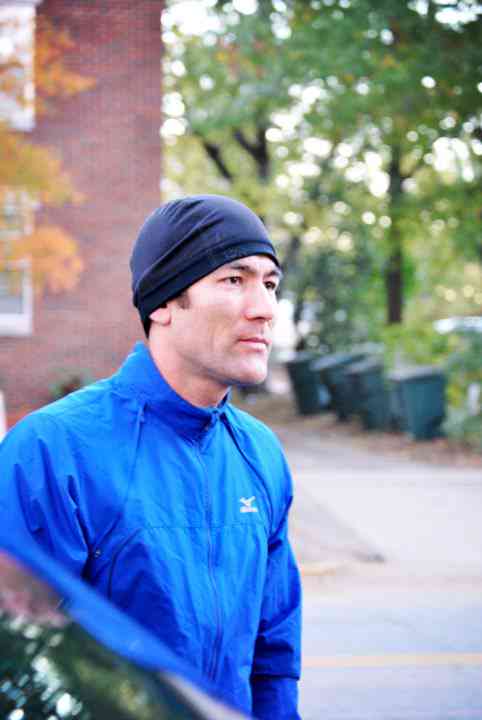
7 for 7: Philosophy

I must be very deep in thought at this moment.

Running philosophy. Man, is that a big topic to bite off, or what? It goes without saying (but I’m going to anyway) that there are plenty of philosophies on running out there. You have your “I just don’t get it” crowd, the bare-minimum amount of running fitness people, and the “can’t live without it/running is life” hardcores. There are even running philosophers: “Would you consider this workout an existential experience or more Socratic in method?”

My personal philosophy on running guides my approach to the sport, and it took me until this year to really put things together. I’m not going to tell you I came up with this totally on my own – Mark Twight’s articles on http://www.gymjones.com helped me pull together a decade worth of random thoughts. My running philosophy is based on a single premise: elitism. But it is not an “I’m better than you” brand of snooty country-club approach. My elitism looks like this: I’m better than me.

Confused?

Think about this…contrary to what we’re told from youth onward in order to build a healthy level of self-esteem, not everyone can be a winner. Sorry, but that’s just the way it is. There’s one first-place, and that’s where the elite finds himself if not often, then at least occasionally. To put myself under the microscope, I will never be an elite runner. You won’t see me winning Boston or chewing on a gold medal. Ever. I might climb the age-group rankings or someday the masters, but there will always be that caveat. Bummer. That’s just how it is, but this is the break point between mine and what I feel is the average attitude.

While actually being elite is beyond 99% of us, the elite mindset is something we can all share.

It is the endless pursuit of a better you, and a focused effort towards achieving that goal. Your non-elitist is the first to casually toss this out in conversation: “I could never (fill in the blank with and athletic feat).”

My response: “Really? How do you know? Have you tried? Have you failed? Have you picked yourself up and tried again?”

With great exception, the answer is no. It’s a cop-out, a lame excuse to get out of putting in any work in the first place. All I hear is laziness and/or fear. Psychologically, it’s a brilliant reinforcement for mediocrity. The response ought to be, “I don’t know if my full potential looks like that, but I’m pushing for whatever it is. I am not afraid to fail.”

The elite mind, then, is two things: 1) Willing to put in the work in order to realize potential and 2) Willing to overcome the fear of failure.

So, let’s bring this back to my philosophy on running and its foundation of elitism. As a runner, I am in pursuit of my full potential, and I orchestrate all efforts in support of that end goal. The ideal me is faster, stronger, and mentally unbreakable. The ideal me is the best runner possible at that particular place and time, and only I can judge whether or not I’ve achieved it. I work damn hard at achieving my goals, and despite having failed exponentially more times than I’ve succeeded, I continue to seek excellence. If it doesn’t mean I’m an elite, then I’m going to get as infinitely close as possible.

So, is this all well and good for me, but not really applicable to anyone else? Think you need to be “good” at something? Hardly. Elitism embodies the idea that the Journey could very well be the Destination. And (cue the chorus) it isn’t limited to running, or even athletic endeavors for that matter. But sticking to running, let me tell you how elitism fits for someone besides myself.

Most of you know my wife, Jen, ran the Chicago Marathon in October in 4:29. It’s not a particularly fast time, and she’ll tell you that herself. I firmly believe, however, that she embodied elitism in her undertaking. For example, did you know that this was her first race since high school? I also bet you don’t know that six months before Chicago, she could barely run three miles without feeling like death. With no background, no training, and nothing but faith, she set her goal of running a marathon, and doing so as fast as possible. Tell me she didn’t face a high risk of failure in this endeavor. And her work ethic? Committed, despite having do the hardest parts of her training in the middle of a South Carolina summer. Through the heat, the inglorious grind of accumulated training; even injury proved no match for her will. On race day, despite having missed several weeks of training, she put it all behind her. She went for it, and succeeded.

Inspired. It is the only word I can use to describe how I felt following her around the course on Oct 10th. While I am certainly emotionally biased (she’s my wife after all), I can honestly say that anyone who goes for it like that is an inspiration to me.

So, I guess that’s it on My Philosophy on Running, which I guess I could have titled “Elitism: Turns Out, It’s for Everybody.” I hope you found it thought-provoking, maybe even humorous. Feel free to take shots at me in the comments section…

Tomorrow, the next installment of 7 for 7: My love/hate relationship with all the crap you have to do before you actually get to the starting line.

7 for 7: An Introduction

I’ve gotten a few prods over the past year to talk about a few things related to the running aspect of Run For Something. To tell you the truth, I’m a bit uncomfortable with the concept, for a couple of reasons. For one, I’m certainly no expert. I may have experience, but expertise is a whole other ball of wax. I also feel like I already put way more effort into writing about my running and racing than I put into talking about aid. But, in the spirit of works-in-progress everywhere, I’ll take a shot at it.

7 for 7 will be a seven day, seven post series on my take on running. I’m going to cover the following areas: Philosophy, Training, Resources, Recovery, Mindset, Racing, and Injury. I’m not going to spend a lot of time on the science or research behind the areas, but I will recommend some resources if you feel like learning a little more. If you have questions or want to challenge me, leave a comment so we can dialogue! Debate and some give-n-take are good for the mind. Finally, with my time challenges, I apologize if some of the posts seem shorter than they should. One of my goals with 7 for 7 is to build better blog frequency habits.
See you tomorrow…

Race Report and Update: Governor’s Cup 8k (13 Nov 10)

“On your left.”

Nothing.

“On your left!”

Still nothing.

“ON YOUR LEFT!” I find myself running sideways trying to slip past the guy with no concept of someone trying to pass on his left, and our shoulders collide as I pass.  “On your left means on your left,” I gasp as I haul ass past him, leaving out a long list of choice pronouns I’d like to tack on to the end of that sentence.  The issue at hand is that the front of the Governor’s Cup 8k pack  is running into the back of the Governor’s Cup Half Marathon. The races share the same course for the first 2+ miles, and the race direction started the 8k a scant ten minutes after the half-marathoners took off.  Now I’m bobbing and weaving through the crowd, just hoping this isn’t going to slow me down.

There’s one guy ahead of me, and he’s far enough out of my league for me to not even think about him. He’s a local masters runner who’s allegedly been training only a few weeks now, but that’s what he always says before he shows up and throws down a 15 minute 5k. Anyway, I dropped the only other guy around 1.5 miles, which was disappointing because I was hoping not to run solo for the back half of the race. But, here I am again in no-man’s land with only myself for a pacer.

After we break from the half-marathon course, everything falls strangely silent. There are no spectators, no nothing at this point. At Mile 3 I hit my watch and don’t like what I see: 12s slow for the last mile. This is the point in a race where I struggle the most. In the past, I might have simply packed it in, and given up any hope of running near my goal. But I’ve worked very hard on my mental game in the past couple years. I tell myself it was a slow mile as a result of all the bobbing and weaving. I know the next mile is all flat/downhill, so I decide the best thing is to push the next mile very aggressively.

Rebounding after a slow mile...

Shortly after this, I see Jen, who has borrowed a bike and is riding around snapping pics of me and our friends Matthew and Steph Whitis, who are both running the half.

“Yeah! You look HOT!!!”

I can’t resist smiling even as I focus on going 20s faster this mile.

My watch at Mile 4 shows a 5:20 split, which puts me back on track to finish in the upper 27s for 8k. I’m back where I need to be, and to tell the truth, feeling pretty good. I’m working very hard, but think I can probably maintain this pace over the next mile.

There are now some scattered spectators as I draw closer to the finish. Then I see it: the half-mile uphill standing between me and the finish. It doesn’t look that bad, I think. But as I begin my ascent I quickly find my stomach growing more and angry at the amount of growing acidity in my body. Uh-oh. Red-line City.

Then begin the crippling dry heaves.

I feel my pace slipping.

The grade slackens, but I am suddenly overcome by an overwhelming urge to stop and throw up. At this point I feel like I am crawling.

Don’t you stop. You want to throw up, fine. But you’re at least going to be moving when you do it So I keep moving, making awful gagging sounds and faces.

About 100m out, in sight of the finish line, all the spectators, and most importantly, the race photographers, the gig is up. And so is whatever’s in my stomach, which thankfully isn’t much.

I manage a semblance of a sprint, and cross the finish in 28:12, happy to be done with it.

In retrospect, it was not a bad race. It highlighted some weak areas in my training, and as my first race in five months, not a bad start. Most important for me was the lesson of mental tenacity. Being alone out there in a race when things aren’t going as planned is a tough spot. Ten years ago (a decade? Has it really been that long?) the demons would have been in charge. As a collegiate runner, my number one struggle was my head and overwhelming negativity. More than likely, I’d have mentally quit and coasted the remainder. This time, though, I fell back on some tried and true techniques – positive mental chatter and form cues – to help get me back on track. Unfortunately, my fitness level wasn’t quite on par with the course demands, but that’s an easy fix: train harder. On a humorous note, check out http://orders.racephotonetwork.com/QPPlus/Images.aspx for some funny pictures of me in the middle of the dry heaves both on the hill and approaching the finish.

Whitis and Me

As for the results, I was second overall, first in my age group, and the proud recipient of a $55 check. The time was also *technically* an 8k PR, although I was faster in the first 8k of the Reedy River 10k back in Feb.  In the half, my friend and training partner Matthew Whitis (the dude in red next to the handsome gent in blue ) ran away from the field in 1:14 and finished first, which was awesome.  Over the past year, I’ve trained with Matthew more than any one person since running in college. We do most of our long runs together and occasionally help each other through some of our quality sessions. He’s getting ready for the Rock n’ Roll Phoenix Marathon in mid-Jan, and I expect he’ll be one of the top masters there. The dude eats high-mileage weeks for breakfast, logging 100-120 with complete nonchalance. When I start to think my mileage numbers are a big deal, all I have to do is ask Whitis what he ran last week and I get an instant ego check.  

Since the race, I’ve increased both my mileage and intensity. Hill repeats, track intervals, mixed tempo sessions – “It’s all deadly,” to quote a favorite movie. I’m hoping I can break 17:00 before Christmas, and looking at a fast 5k in Greenville on 23 Jan as being a good place to target 16:30.